
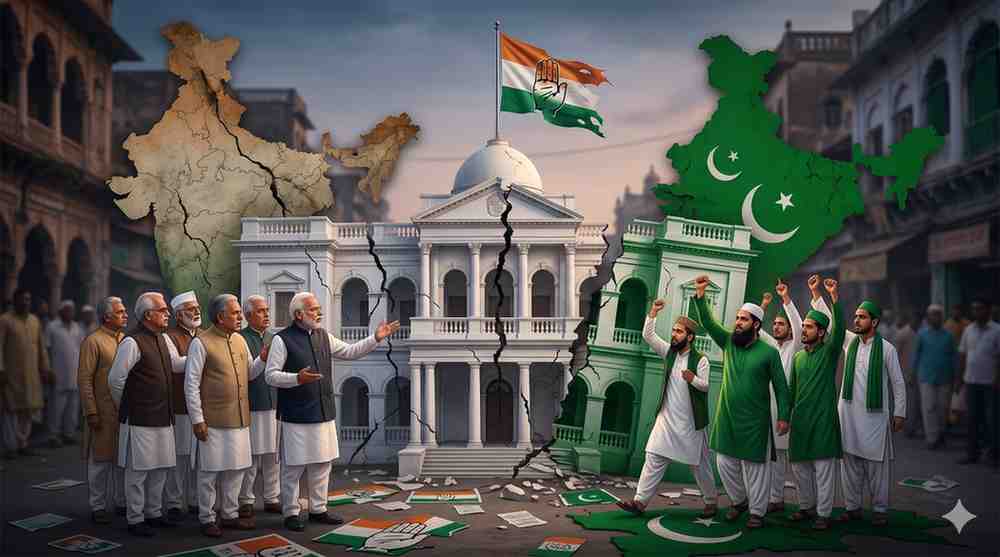
New Delhi, May 2026 — The Indian National Congress finds itself battling an existential perception crisis as recent assembly election results in Assam and Kerala paint a startling demographic picture.
What political rivals call the unmasking of a “New Muslim League,” Congress defenders describe as a victory for inclusive democracy against radical forces. But beneath the rhetoric lies a deep demographic shift that is reshaping Indian politics.
The Numbers Behind the Shock For decades, Congress prided itself on being an “umbrella party” accommodating diverse demographics. However, recent verified data reveals a sharp departure. In Assam, out of 19 winning Congress MLAs, 18 belong to the Muslim community. Similarly, in Kerala, 30 out of 35 MLAs elected under the Congress-led United Democratic Front (UDF) are Muslims. The illusion of a diverse representation in these states has vanished, leaving the party reliant on a single community.
The Delimitation Trap in Assam This absolute polarization in Assam didn’t happen by accident. Chief Minister Himanta Biswa Sarma masterminded a strategic constituency delimitation. By redrawing administrative boundaries just before the Election Commission’s deadline, minority-dominated pockets were compressed into a few specific constituencies. The result? Congress candidates won these isolated seats with massive margins, but the surrounding areas were permanently secured by indigenous Hindu majorities.
Allies Turn Foes: The “Muslim League 2.0” Tag The most lethal blow to Congress’s secular credentials didn’t come from the Right Wing, but from their former ally. Badruddin Ajmal, chief of the All India United Democratic Front (AIUDF), was wiped out in the elections. In his frustration, he publicly branded Congress as “Muslim League 2.0.” Ajmal accused Congress of abandoning positive politics and instead using the “fear of Hindutva” to aggressively monopolize minority votes.
Local Data, National Narrative The BJP immediately weaponized this local data. From top spokespersons to the Prime Minister, the message was clear: a party that relies entirely on minority appeasement in Kerala and Assam has lost the trust of the Hindu majority. It was a psychological masterstroke aimed at alienating Congress’s remaining voter base in the Hindi heartland.
The 78% Hindu Defense Facing an existential threat, Congress fired back with hard national data. Media Chairman Pawan Khera presented a broader picture: out of approximately 664 Congress MLAs nationwide, 57—or 78%—are Hindus. Congress argued that their representation perfectly mirrors national demographics (80% Hindu, 14% Muslim). Furthermore, they claimed that minorities rejecting radical outfits like AIUDF to vote for a mainstream party was actually a triumph of secularism.
The Reverse Consolidation Danger Despite the data defense, politics runs on perception. Political analysts note that Congress has walked into a “reverse consolidation” trap. While fear-driven minority voting secured 15-20 seats for Congress in the short term, this aggressive 20% consolidation naturally polarizes the remaining 80% majority in reaction—a dream scenario for the BJP.
Bottom Line The era of broad-based coalition politics in these states is fracturing. Congress is now caught in a classic Catch-22 ahead of the 2029 elections: embrace the minority vote bank and risk being branded a communal party in the North, or reject it and face electoral oblivion. With the “Muslim League 2.0” narrative firmly planted, the grand old party must prove whether it is still a national voice, or simply a captive to regional identity politics.
Leave a Reply