
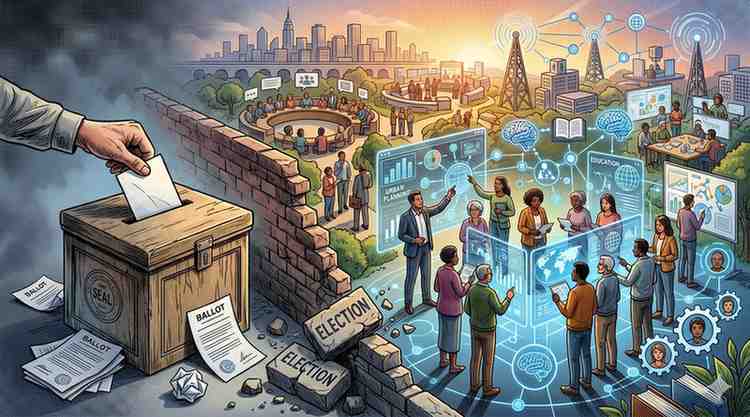
NEW DELHI, May 2026 — As global democracies grapple with the rising influence of “money and muscle power,” a radical theoretical concept is gaining traction: Lottocracy. In a world where the 2024 Indian General Elections cost a staggering ₹1 lakh crore and nearly 46% of sitting MPs face criminal charges, political theorists are asking a provocative question: Is the election process itself harming the very democracy it was designed to protect?
The Crisis: Managed Elections and the “Plutocracy” Trap
For years, critics have argued that modern elections have become “highly managed” spectacles. Instead of being a true representation of the people, legislatures are increasingly dominated by a “microscopic elite.” Data from recent Indian parliaments shows a steady increase in both “crorepati” (millionaire) MPs and those with serious criminal records.
This disconnect has led to what some call a Plutocracy—a government run by the wealthy. In this system, the common citizen is left to choose between elite candidates pre-selected by political parties, leading to a sense of political apathy and systemic erosion of public trust.
The Radical Solution: Lottocracy
The alternative being discussed is Lottocracy, or “democracy without elections.” Drawing inspiration from Ancient Athens, this system replaces voting with a lottery:
- Selection by Lot: Citizens are chosen at random to serve in legislative assemblies, similar to a jury duty system.
- The End of Funding: Since there is no campaigning, the need for corporate donors and “dark money” vanishes overnight.
- Breaking the Nexus: By removing the “winner-takes-all” electoral battle, the incentive for politicians to partner with criminals for “muscle power” is eliminated.
From Theory to Practice: Citizen Assemblies
Lottocracy is no longer just a utopian dream; elements of it are already being tested in Ireland, Canada, and France. In Ireland, a “Citizen Assembly” chosen via lottery was used to find a consensus on sensitive issues like same-sex marriage and abortion laws, which political parties were too polarized to touch. The results were then used by the formal legislature to draft laws that truly reflected public will.
Analysis: A Reset for the Sport of Politics
Supporters of the “Lottery System” argue it offers a “reset” for democracy. They envision a parliament where a farmer, a teacher, and a shopkeeper sit alongside experts to draft policy. While critics warn of a lack of experience among randomly selected citizens, proponents point out that the current “professional” political class has failed to address critical issues like paper leaks (NEET/SSC) and youth unemployment.
Bottom Line
The era of “Money, Muscle, and Managed Narratives” has turned elections into a tool for the elite rather than a goal for the people. As the tool breaks, the world may have to look back to the ancient past to find a futuristic solution: a democracy where power isn’t bought or fought for, but simply drawn by lot.
Leave a Reply