
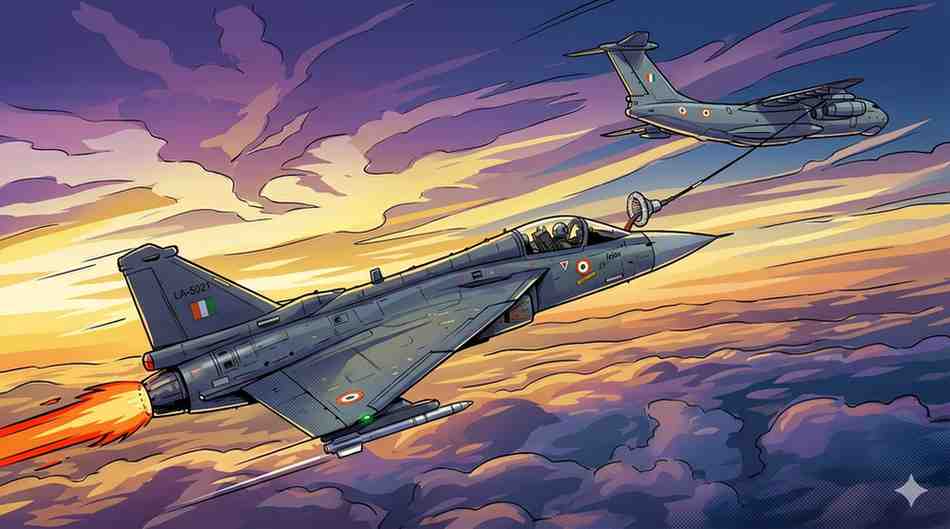
Gwalior, September 2018 — The Indian Air Force (IAF) has crossed a formidable technical threshold as the indigenous Tejas Light Combat Aircraft (LCA) successfully completed its first-ever mid-air refuelling.
The maneuver, executed over the skies of Gwalior, signifies a coming-of-age for the home-grown fighter jet, effectively silencing long-standing critics regarding its operational endurance and mission readiness.
A Precision “Dry Linkup” in the Skies
The mission involved a Tejas LSP-8 (Limited Series Production) aircraft and an Ilyushin-78 MKI tanker. The process required the Tejas pilot to align a probe extending from the cockpit with a fuel basket trailed by the tanker at speeds exceeding 500 km/h.
While this initial test was a “dry linkup”—focusing on the mechanical coupling and stability of the aircraft in the tanker’s turbulent wake—it confirms that the Tejas is now capable of deep-penetration strikes that were previously impossible due to fuel constraints.
Breaking the “Short-Legged” Narrative
Historically, the Tejas was labeled a “short-legged” interceptor, limited by its internal fuel capacity to defensive roles near the border. The integration of Air-to-Air Refuelling (AAR) changes the tactical map entirely:
- Extended Loiter Time: The jet can now remain airborne for hours, providing prolonged combat air patrols.
- Deep Strike Capability: It can fly much deeper into enemy territory or across maritime zones without the need to land at forward bases.
- Increased Payload: By taking off with less fuel and more weapons, the aircraft can refuel once airborne, maximizing its lethality.
Joining the Global Elite
With this successful trial, India enters an exclusive “Super Six” club of nations—joining the USA, Russia, UK, France, and Israel—that possess the domestic technology to design and integrate mid-air refuelling systems into their fighter fleets.
Engineers at the Aeronautical Development Agency (ADA) and Hindustan Aeronautics Limited (HAL) spent months perfecting the flight control laws to ensure the aircraft remained stable while “hooked” to the tanker, a task often described by pilots as “trying to thread a needle in a wind tunnel.”
The Strategic Shift
For the Indian Air Force, this is more than just a technical win; it is a strategic force multiplier. As the IAF moves toward inducting more Tejas squadrons, the ability to refuel mid-flight allows these smaller jets to take over roles typically reserved for heavier, more expensive twin-engine fighters.
Bottom Line
The first mid-air refuelling isn’t just about fuel—it’s about reach. By proving that the Tejas can be sustained in the air indefinitely, India has transformed its light combat aircraft from a localized defender into a versatile, long-range predator, marking a definitive victory for the “Make in India” initiative in defense.
Leave a Reply