
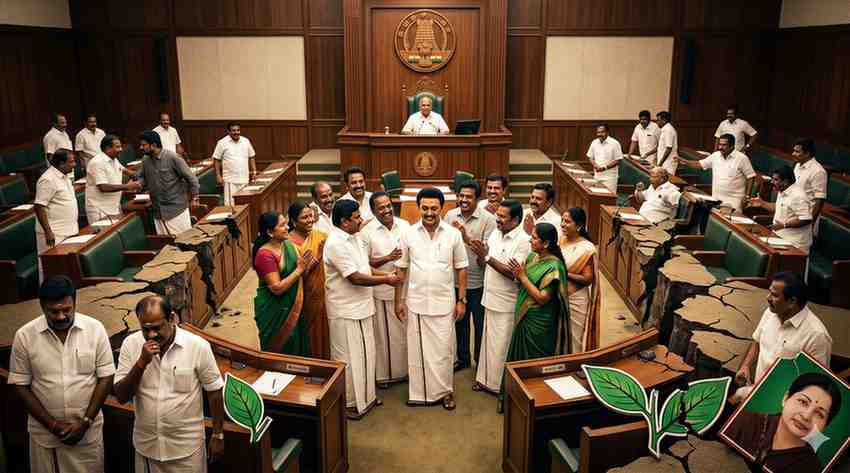
CHENNAI, May 2026 — In a dramatic turn of events that has reshaped the political landscape of Tamil Nadu, the fledgling Tamilaga Vettri Kazhagam (TVK), led by actor-turned-politician Vijay, comfortably won a crucial floor test in the State Assembly yesterday. While the victory secures Vijay’s position as Chief Minister, the real headline is the massive split within the primary opposition, the AIADMK.
The Numbers Game: Surpassing the Majority
Entering the floor test, the political atmosphere was tense. With a house majority mark of 118, TVK initially held 108 seats. However, technicalities—including the CM vacating one of two contested seats and a court challenge to another—brought their direct strength down to 105.
Expectations were shattered when the final tally reached 144 votes in favor of TVK. This surge was fueled by:
- 15 MLAs from the Congress and Left parties.
- 24 rebel MLAs from the AIADMK who defied their party leadership to support Vijay.
The AIADMK Crisis: A House Divided
The AIADMK, once a monolithic force under J. Jayalalithaa, appears to be crumbling under current leader Edappadi K. Palaniswami (EPS). Despite a strict “whip” issued to all 53 party MLAs to vote against the government, nearly half the legislative party defected.
Analysts suggest that the AIADMK’s traditional base—youth and rural voters—is rapidly migrating toward Vijay’s “cinema-oriented mass politics.” For the 24 rebels, supporting the TVK is seen as a survival move in a shifting political tide.
The Legal Tussle: Anti-Defection Law
The political victory now moves into a legal battlefield. Under the 10th Schedule (Anti-Defection Law), an MLA can be disqualified for voting against their party’s whip unless two-thirds of the party merges with another. Since only 24 out of 53 MLAs defected (short of the required 36), they face potential disqualification.
However, the power lies with the Speaker, a TVK appointee. Political history suggests that Speakers often delay such decisions, allowing rebel MLAs to remain in the house for extended periods while the matter is contested in the courts.
DMK’s Strategic Silence
Interestingly, the DMK chose to abstain from the vote. Observers believe this is a calculated move to avoid the optics of standing alongside the AIADMK. By allowing the AIADMK to implode, the DMK hopes to clear the field for a direct future showdown: DMK vs. TVK.
Bottom Line
Vijay’s government now enjoys a “psychological majority,” giving him the mandate to govern without the constant threat of a collapse. However, with the AIADMK leadership purging rebels and moving toward legal action, Tamil Nadu’s political drama is far from over. The “actor-Chief Minister” has won the first act, but the real test of governance begins now.
Leave a Reply