
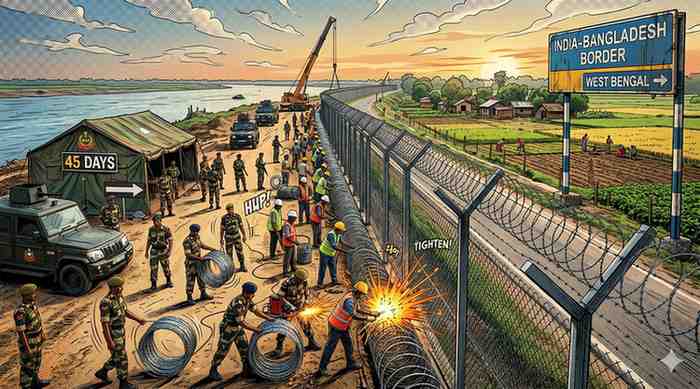
KOLKATA — In a landmark decision that signals a major shift in India’s border management strategy, the newly formed West Bengal government has cleared the immediate transfer of land to the Border Security Force (BSF). The move aims to complete the long-stalled fencing of the 4,096 km India-Bangladesh border, ending years of administrative deadlock.
Ending the “Porous Border” Era
For decades, the Indo-Bangla frontier has been described as one of the most complex and “porous” borders in the world. Unlike the heavily fortified Line of Control (LoC) with Pakistan, large stretches of the Bengal border remain unfenced, running through dense forests, rivers, and even dividing villages in half.
During his first cabinet meeting, Chief Minister Suvendu Adhikari authorized the transfer of critical land parcels to the BSF, setting a 45-day deadline for the process to be finalized. This decision marks a sharp departure from the previous administration’s policy, which frequently stalled land acquisition citing local land-holding concerns.
The Deadly Cost of Delay
The urgency of the project was highlighted just days ago when a violent confrontation broke out in the Tripura sector. BSF personnel, conducting night surveillance against a group of suspected cattle smugglers, were forced to open fire in self-defense after being pelted with stones.
The incident resulted in the deaths of two Bangladeshi nationals. Security experts argue that such “hot encounters” are a direct result of missing physical barriers, which force soldiers into dangerous, face-to-face confrontations with aggressive smuggling syndicates in the dark.
A Multi-Billion Dollar Shadow Economy
The lack of fencing has allowed a massive illegal economy to thrive. According to security reports, the cross-border movement is not just about people; it is a sophisticated logistics network:
- Outbound (India to Bangladesh): Smuggling of cattle, subsidized fertilizers, diesel, and consumer electronics.
- Inbound (Bangladesh to India): Trafficking of narcotics, fake Indian currency notes (FICN), and undocumented migrants.
- Human Cost: The porous nature of the border has made it a primary route for human trafficking, often exploiting women and children from vulnerable backgrounds.
The “Zero Line” Diplomacy
One of the biggest hurdles in fencing has been the “Zero Line” rule—an international agreement that prohibits permanent structures within 150 yards of the boundary. This creates a “no-man’s land” where Indian villagers often find their homes or farms trapped outside the fence but inside Indian territory.
While the previous government used this “Zero Line” hardship as a reason to delay, the new administration has signaled it will work with the Ministry of Home Affairs (MHA) to provide technical solutions and compensation, prioritizing national security over local administrative hurdles.
Strategic Re-alignment
The completion of the fence is more than an engineering project; it is a political statement. By aligning the state’s border policy with the Central Government’s “Double Engine” model, West Bengal is moving toward a hardline security stance.
As the BSF takes full control of these newly allocated tracts, the goal is clear: to transform a fluid, dangerous boundary into a regulated international border, effectively shutting the door on the era of unchecked infiltration.
Leave a Reply