
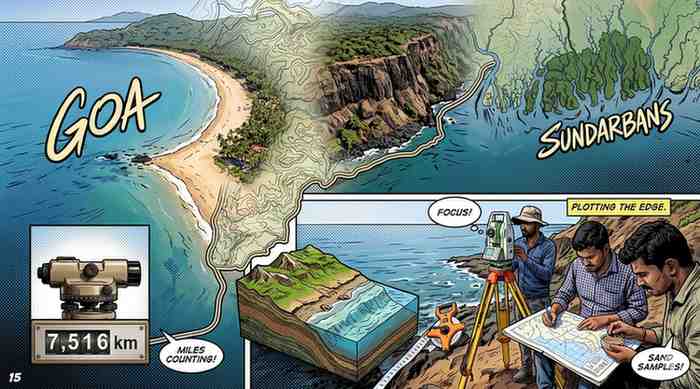
New Delhi, May 2026 — India is defined by its relationship with the sea. With a coastline spanning 7,516.6 km—touching nine states and four union territories—the nation’s maritime geography is a massive engine for trade, climate, and security. From the jagged cliffs of the west to the fertile deltas of the east, this boundary is a geological masterpiece millions of years in the making.
The Western Seaboard: Narrow, Rugged, and Wild
The West Coast, stretching from the Gulf of Khambhat down to Kanyakumari, is a “submerged” coast characterized by narrow plains and a steep drop-off into the Arabian Sea.
- The Gujarat Frontier: In the north, the Rann of Kutch and Kathiawar Peninsula represent a unique saline desert. Once a group of islands, these were eventually joined to the mainland by silt brought by the Indus and other rivers.
- The Waterfall Corridor: As you move through the Konkan and Kanara coasts, the Western Ghats stand tall, forcing rivers to descend in dramatic leaps. The most famous is Jog Falls in Karnataka, which plunges 271 meters toward the coast.
- The Backwater Kingdom: The Malabar Coast of Kerala is defined by its Kayals—shallow lagoons and backwaters that run parallel to the sea. The 75 km-long Vembanad Lake is the crown jewel of this unique ecosystem.
The Eastern Seaboard: The Great Delta Land
In stark contrast, the East Coast is an “emergent” coast, significantly wider and more extensive than its western counterpart. It is the result of massive sediment deposits from India’s greatest rivers: the Mahanadi, Godavari, Krishna, and Kaveri.
- The Utkal & Northern Circars: The northern stretch features the Utkal Plain, home to Chilika Lake. As Asia’s largest brackish water lagoon, it serves as a critical wetland for global biodiversity.
- The Advancing Coastline: The Godavari and Krishna deltas have been so active that they have pushed the coastline into the sea by nearly 35 km over the centuries. This sediment “growth” turned Kolleru Lake from a coastal lagoon into an inland freshwater body.
- The Coromandel: Further south, the Tamil Nadu Plain (Coromandel Coast) stretches toward the tip of the peninsula, offering a broad, fertile belt that has supported civilizations for millennia.
A Tale of Two Coasts: Ports vs. Deltas
The difference between the two sides determines India’s economic strategy. The West Coast, with its deep-water indentations and creeks like Thane, provides world-class natural harbors for heavy shipping. Meanwhile, the East Coast, with its wide plains and shallow deltas, is the nation’s agricultural heartland, though it lacks the natural deep-water ports of the west.
Bottom Line
India’s coastline is not just a beach; it is a dynamic frontier. While the west offers the infrastructure for global trade, the east provides the fertile ground that feeds millions. From the salt-soaked Great Rann to the palm-fringed Malabar and the sediment-rich Coromandel, the coast remains India’s most strategic and diverse geographical asset.
Leave a Reply