
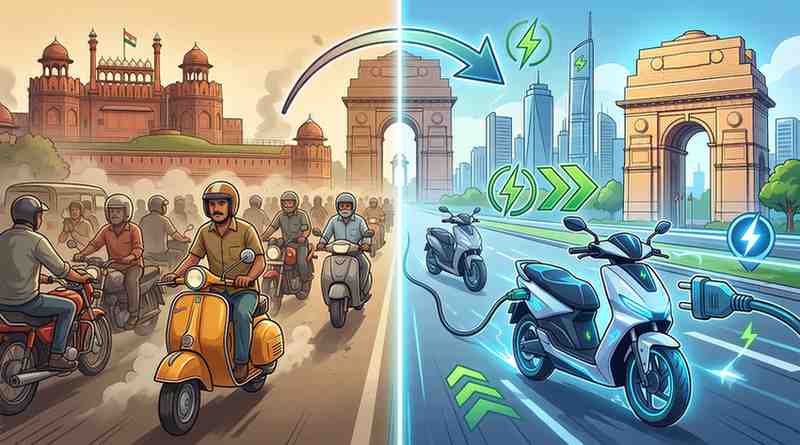
New Delhi, July 2026 — The Delhi government has unveiled an ambitious roadmap to transform the capital’s transport sector, announcing a complete phase-out of new petrol-powered motorcycles and scooters by April 1, 2028. This policy marks a significant shift in India’s battle against urban pollution, positioning the national capital as a testing ground for large-scale fossil fuel reduction.
The “Pollution-First” Mandate
For years, Delhi has grappled with hazardous air quality, particularly during winter months. Data indicates that transport is the single largest contributor to this crisis, with vehicular emissions accounting for roughly 23% of the city’s PM2.5 levels.
Two-wheelers currently dominate Delhi’s roads, making up nearly two-thirds of all registered vehicles. Consequently, they are responsible for 31% of the city’s transport-related PM2.5 emissions. By mandating that no new petrol-run two-wheelers be registered after the 2028 deadline, officials aim to ensure that at least 30% of Delhi’s vehicle fleet is electrified by March 31, 2030.
A Multimillion-Rupee Incentive
To drive this transition, the government has earmarked ₹15,000 crore to bolster the electric vehicle (EV) ecosystem. The policy focuses on two main pillars:
- Direct Subsidies: To lower the entry barrier, the government is offering significant purchase incentives. Buyers can expect subsidies of up to ₹30,000 in the first year, with the amount scaling down to ₹20,000 and ₹10,000 in the second and third years, respectively.
- Infrastructure Expansion: Recognizing that “range anxiety” is a barrier, the government has committed to installing over 30,000 EV charging points across the city to create a robust and reliable network.
An Industry at a Crossroads
While the policy is a major environmental milestone, it presents complex hurdles for the broader economy:
- Manufacturers: Major Indian brands—global leaders in the two-wheeler sector—must now rapidly pivot their R&D efforts. While Delhi contributes only about 2.6% of India’s total two-wheeler sales, the policy sets a precedent that could ripple across the national market.
- The Service Sector: Local repair shops and mechanics, who have built their livelihoods around internal combustion engines, face an urgent need for re-skilling. The shift to electric powertrains requires new technical expertise and significant capital investment in diagnostic equipment.
The Consumer Question
Despite the government’s optimism, skepticism remains among the public. Commuters who rely on two-wheelers for long-distance daily travel have voiced concerns regarding battery life, the long-term reliability of EV technology in Delhi’s extreme climate, and potential resale values.
The success of this mandate will ultimately hinge on the government’s ability to prove that an electrified Delhi is not only cleaner but also practically viable for every resident, regardless of their daily commute or economic background.
Would you like me to elaborate on the specific technological challenges or the economic impact of this policy on local manufacturing?
Leave a Reply