
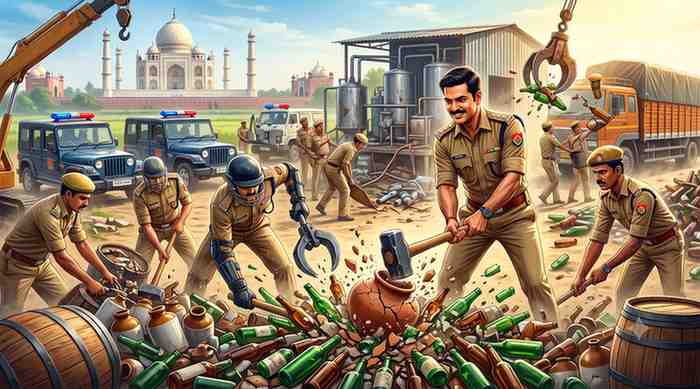
Lucknow, July 2026 — The dismantling of Uttar Pradesh’s notorious liquor mafia has brought an end to a violent parallel economy that once dictated the state’s governance. What the administration describes as a decisive triumph of law and order, experts call a structural masterclass in uprooting institutionalized crime that had held the state hostage for decades,.
The Blueprint of a Political Syndicate
Before 2017, the country liquor trade in Uttar Pradesh was not a normal business; it was a ruthlessly protected monopoly,. Run by a powerful cartel with deep political connections, this syndicate functioned as a shadow government,. A single phone call from a mafia don could dictate the postings of District Magistrates and police chiefs.
The cost of this cartelization was paid in human lives. Every year, mass tragedies occurred as low-income laborers drank toxic, adulterated alcohol produced by the mafia,. The system remained silent because illicit cash lined the pockets of officials from local police stations to the state secretariat.
Breaking the Monopoly Through Policy
When Chief Minister Yogi Adityanath took office in 2017, the state recognized that traditional police raids would not suffice against a multi-crore financial empire,. The first major blow came with the 2018 New Excise Policy, which banned anyone from holding more than two liquor shop licenses,. In a single stroke, decades of retail and wholesale monopoly collapsed.
To eliminate systemic corruption, the government replaced human discretion with a digital e-lottery system, opening the market to small businessmen and farmers,. To halt tax evasion, a state-of-the-art “Track and Trace” system was implemented. Every bottle received a high-security, QR-coded hologram, allowing real-time tracking from the distillery to the counter and freezing out the mafia’s unrecorded manufacturing lines,.
Bulldozers and the Law of Fear
On the ground, the administration launched “Operation Clean” with a mandate of zero tolerance. Intelligence networks targeted historic bootlegging hubs along border districts and river belts. Just this month, a major enforcement drive along the Sarayu River in Basti completely destroyed a massive covert manufacturing operation.
Crucially, the state stopped treating bootleggers as ordinary criminals. Authorities invoked the गैंगस्टर एक्ट (Gangster Act) and the National Security Act (NSA), allowing the government to seize and bulldoze properties built on illegal wealth,. The psychological impact was immediate. Hardcore criminals began walking into police stations holding placards, surrendering voluntarily out of fear of state action,.
The ₹57,000 Crore Rebound
The economic and social shift has redefined the state. Before 2017, the state’s annual excise revenue stagnated between ₹14,000 and ₹17,000 crore, with the remainder siphoned into the black economy to fund criminal and political networks,.
By the 2025–2026 cycle, Uttar Pradesh’s excise collection skyrocketed past ₹57,000 crore—a near 300% surge that makes it the highest revenue-generating state in the sector,. These public funds are now directly financing mega-infrastructure projects like the Purvanchal and Bundelkhand Expressways, alongside new medical colleges. Concurrently, mass deaths from toxic liquor have dropped to zero, and the elimination of illegal dens has triggered a notable decline in rural domestic abuse and alcohol-related health crises,.
Bottom Line
The “Uttar Pradesh Model” proves that institutionalized syndicates cannot be beaten by ad-hoc policing alone,. By combining an unyielding political will with digital tracking tools and aggressive financial crackdowns, the state successfully reclaimed its governance, proving that even the most entrenched criminal systems can be dismantled when the state strikes at their roots,.
Leave a Reply