
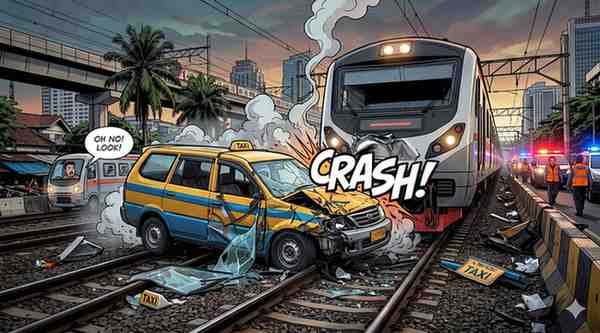
Jakarta, April 2026 — A routine commute turned into a scene of horror near Jakarta, Indonesia, after two trains collided in a high-impact crash that has left the nation in mourning. The disaster, which has claimed at least 15 lives and injured 88 others, was reportedly triggered by a freak accident involving a local taxi.
The Fatal Chain Reaction
The catastrophe began when a taxi stalled while attempting to cross a set of railway tracks. According to initial reports, the vehicle became stuck in the path of an oncoming train. While the driver managed to escape the vehicle, the impact of the train hitting the car caused a derailment that sent the locomotive careening into the path of another passenger train traveling in the opposite direction.
The force of the collision was captured in harrowing footage by a passenger on board [00:00:08], showing the interior of the carriage violently shaking as commuters were thrown from their seats amid the sound of twisting metal.
A Scene of Devastation
The aftermath at the station revealed the sheer scale of the impact. Images from the site show one train engine completely Mangled, with its front end crushed into a heap of yellow and white steel. The second train was forced off the tracks, its carriages tilting precariously as rescue workers scrambled to reach those trapped inside [00:00:01].
Emergency services arrived within minutes, but the complexity of the wreckage made the rescue operation grueling. Of the 88 injured, several remain in critical condition at nearby hospitals, with authorities fearing the death toll could still rise.
Infrastructure and Safety Under Fire
This deadly incident has reignited a fierce debate regarding railway safety and the prevalence of unprotected level crossings in Indonesia. Urban experts are raising critical questions:
- Crossing Guards: Why was the taxi able to enter the tracks with trains approaching?
- Emergency Protocols: Could automated signaling systems have prevented the second train from entering the collision zone?
- Urban Encroachment: The proximity of high-density traffic to rail lines continues to be a recipe for disaster in Jakarta’s outskirts.
The Indonesian Ministry of Transportation has launched a full-scale investigation into the crash, focusing on both the taxi driver’s actions and the potential failure of railway safety barriers.
The Bottom Line
What should have been a safe journey ended in a mass-casualty event due to a single stalled vehicle. As Jakarta continues to modernize its transit systems, this tragedy serves as a grim reminder that high-speed rail technology is only as safe as the crossings it traverses. Until the gap between road traffic and rail tracks is bridged with better safety infrastructure, the lives of thousands of daily commuters remain at risk.
Leave a Reply