
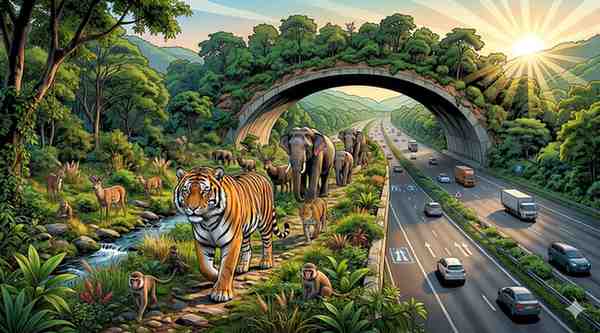
DEHRADUN, May 2026 — India’s infrastructure landscape has reached a historic turning point. With the near-completion of the ₹12,000 crore Delhi-Dehradun Expressway, the spotlight has shifted from high-speed transit to a groundbreaking environmental achievement: Asia’s longest elevated wildlife corridor.
While the project successfully slashes travel time from 6.5 hours to just 2.5 hours, its true legacy lies in proving that rapid industrial growth does not have to be a death sentence for India’s biodiversity.
Engineering a Forest in the Clouds
The centerpiece of this 210-km expressway is a 12-km elevated stretch designed to float above the forest floor. This section traverses the highly sensitive Rajaji Tiger Reserve and the Shivalik Elephant Corridor, areas where traditional ground-level highways have historically led to catastrophic habitat fragmentation and animal fatalities.
To ensure seamless migration, the project includes:
- 8 Dedicated Animal Passes: Strategically placed for local fauna.
- 2 Major Elephant Underpasses: Each 200 meters long with high clearances to accommodate the largest bulls.
- 370-Meter Tunnel: Constructed near the Dat Kali Pass to minimize noise and light pollution in the heart of the jungle.
The Proof is in the Footage
Skeptics of “green infrastructure” have been silenced by a comprehensive 40-day study conducted by the Wildlife Institute of India (WII) and NHAI. Using 150 camera traps and 29 acoustic recorders across an 18-km stretch, researchers captured over 100,000 images that tell a story of immediate adaptation.
The data confirms that 18 different species have already claimed the corridor as their own. While the golden jackal, nilgai, and spotted deer are the most frequent commuters, the crowning success is the safe passage of wild elephants, which were recorded using the underpasses more than 60 times during the study period.
A Lesson from Past Tragedies
The success of the Ganeshpur-Ashrori stretch serves as a bitter-sweet reminder of what might have been. Conservationists point to frequent, tragic train-elephant collisions in states like Assam, noting that if similar elevated corridors had been prioritized there, hundreds of elephants could have been saved.
The Bottom Line
The Delhi-Dehradun Expressway marks the end of the era where “development” meant a bulldozer through a sanctuary. By investing in elevated corridors, India is setting a global benchmark: the “Smart Highway” of the future isn’t just about how fast humans can move, but how safely our wildlife can stay still in their own homes.
As the project nears its full public opening, the message is clear: our progress no longer needs to collide with our nature.
Leave a Reply