
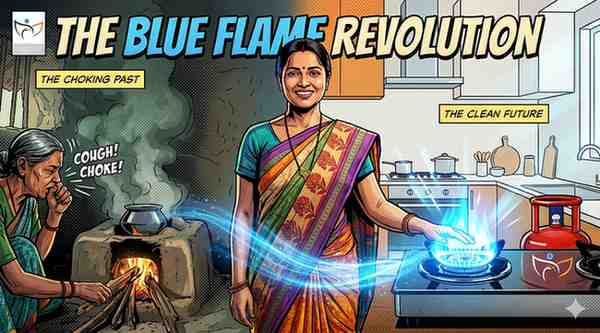
New Delhi, April 2026 — For decades, the kitchens of rural India told a silent story of struggle. Millions of women spent their lives battling thick clouds of smoke, spending grueling hours collecting firewood and dung cakes just to prepare a basic meal. Today, that narrative of hardship is being rewritten by the Pradhan Mantri Ujjwala Yojana (PMUY), a scheme that has ignited a revolution of health and empowerment across the nation.
With over 10.3 crore LPG connections distributed, the program has successfully transitioned a massive segment of the population from hazardous traditional fuels to clean, efficient cooking gas.
The Hidden Cost of the “Chulha”
Before the advent of Ujjwala, cooking was a silent health crisis. The “chulha” (traditional stove) turned homes into smoke-filled chambers, leading to chronic respiratory issues equivalent to smoking hundreds of cigarettes a day.
Beyond the health toll, the opportunity cost was staggering. Women like Sukshma Chaudhary, residing in remote riverbank villages, often spent 4 to 5 hours a day merely gathering fuel. This was labor that went unpaid, unrecognized, and physically exhausting, keeping millions of women trapped in a cycle of domestic drudgery.
Reclaiming the “Time Dividend”
The shift to LPG has done more than just clear the air; it has gifted time back to the nation’s women. On average, Ujjwala beneficiaries are now saving 2 to 3 hours every single day. This “time dividend” is being reinvested into the rural economy:
- Income Generation: Women are utilizing these hours for small-scale poultry, tailoring, and local handicrafts.
- Education & Family: More time is available to supervise children’s schooling and engage in community health programs.
- Dignity: The transition fosters a sense of social standing and self-reliance (Atmanirbharta) that was previously smothered by soot and ash.
Subsidizing Sustainability
To ensure that this change wasn’t a one-time event, the government implemented targeted financial support. A ₹300 subsidy per refill has been the cornerstone in making clean fuel affordable for the poorest households. By easing the financial burden of the transition, the scheme ensures that families don’t slip back into using traditional biomass when budgets get tight.
A Resolve for Every Household
The Ujjwala Yojana is proof that a small blue flame can light up more than just a stove—it can illuminate a path to a better life. By providing clean, affordable, and safe fuel, the scheme is fulfilling a national resolve to bring health and empowerment to the last mile.
Bottom Line
The era of “smoke and struggle” is fading. The Ujjwala story is no longer just about providing a cylinder; it is about providing a new direction for the lives of millions of women. With the smoke cleared, the focus has shifted from mere survival to the pursuit of dreams, proving that true empowerment begins right in the heart of the home.
Leave a Reply