
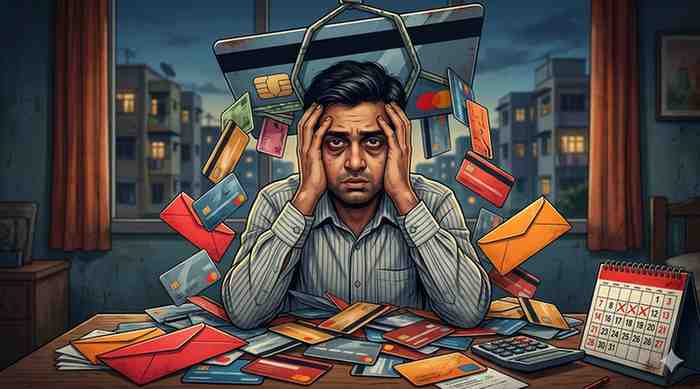
Mumbai, May 2026 — India’s financial landscape is facing a quiet but dangerous transformation. What was once hailed as a digital payment revolution is now being exposed as an “unsecured debt trap.” New data reveals that credit card outstanding balances and personal loan defaults have hit a record high, as millions of middle-class Indians struggle to maintain a lifestyle fueled by easy credit and high-interest cycles.
Selling Luxury as “Affordability”
For years, banks and fintech platforms have marketed credit cards as a tool for financial freedom. Through “No-Cost EMIs” and aggressive rewards programs, they created an illusion of affordability for high-end electronics, luxury travel, and designer fashion.
In reality, the structure was designed to capitalize on the “minimum due” trap. While users felt empowered by making small monthly payments, the compounding interest—often reaching 40% to 45% annually—has left 95% of revolving credit users in a state of permanent debt. The dream of “living the big life” was sold through constant notifications, while the platforms thrived on the interest gathered from these small, persistent financial leaks.
Fintech Promoters: Pushing Plastic, Not Financial Health
From celebrity endorsements to social media influencers with massive reach, credit apps recruited anyone with influence to chant the same line: “Upgrade your life today.” Behind the scenes, however, a massive trust gap has emerged.
Insiders admit that many influencers promoting these cards never carry balances themselves. They were paid handsomely to pretend that managing multiple credit lines is a “smart financial hack.” Mid-tier creators, desperate for brand deals, became the face of high-interest lending, pushing followers toward high-limit cards that they themselves would never use as a primary financial tool.
The “EMI Fever” and the Consumption Bubble
During festive seasons and mega-sales, credit offers took over 80% of digital ad space. Every major purchase was tied to a “buy now, pay later” scheme. What was billed as rising consumer confidence was, in fact, “credit fever” wrapped in aspirational branding. Consumption intensity was inflated by the availability of instant loans, not by actual increases in household income.
The End of Easy Credit for Banks
The Reserve Bank of India (RBI) has recently tightened norms on unsecured lending, creating a massive vacuum in the fintech sector.
- Fintech Startups: Many platforms that relied on high-interest personal loans have seen their valuations slashed by 40% overnight.
- Consumers: For many who used one card to pay off another, that lifeline is gone.
- The Economy: Analysts warn of a ₹3,000 crore gap in discretionary spending as the flow of easy, unsecured credit dries up.
Bottom Line
The era of “Swipe now, think later” was never about financial empowerment—it was about selling hope while quietly draining bank accounts. With the recent regulatory crackdown, the masks are off: those who promoted the “credit lifestyle” rarely lived it, and those who fell for it rarely won. Indian consumers are now facing a stark reset, moving back to a reality where wealth is built on savings, not on a plastic illusion.
Leave a Reply