
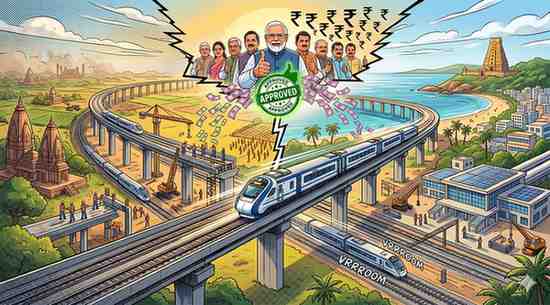
New Delhi, April 2026 — In a massive push to de-clog India’s rail arteries, the Union Cabinet has greenlit two transformative multi-tracking projects in Uttar Pradesh and Andhra Pradesh. With an outlay of ₹24,815 crore, the move marks a decisive step toward eliminating freight bottlenecks and supercharging the country’s logistical backbone.
Under the PM Gati Shakti National Master Plan, these projects will expand the existing railway network by 601 km, cutting through 15 key districts to facilitate the seamless movement of goods and passengers.
Uttar Pradesh: Bridging the North-East Divide
The centerpiece of this announcement is the construction of the third and fourth lines between Ghaziabad and Sitapur. Spanning a massive 403 kilometers, this project is designed to serve as a high-capacity bridge between Northern and Eastern India.
Valued at ₹14,926 crore, the expansion targets the industrial heartland of UP. By doubling the capacity on this stretch, the government aims to:
- Accelerate Freight Flow: Dramatically reducing the transit time for industrial goods and agricultural produce.
- Boost Local Economy: The project is slated to generate 274 lakh human-days of employment, providing a significant livelihood surge for the region.
Andhra Pradesh: Port Connectivity and the Coastal Spine
Further south, the Cabinet has approved the expansion of the Rajahmundry to Visakhapatnam corridor. This 198 km project is a vital component of the Howrah-Chennai high-density network, acting as the literal spine of the East Coast’s trade route.
With a budget of ₹9,889 crore, this multitracking effort focuses on:
- Port Integration: Streamlining the flow of cargo from major maritime hubs like Visakhapatnam to the hinterland.
- Network Resilience: Relieving pressure on one of India’s most congested rail corridors to ensure reliable scheduling.
- Job Creation: An estimated 135 lakh human-days of employment will be created during the construction phase.
Logistics Efficiency: The Gati Shakti Vision
For years, India’s logistics costs have been a hurdle for global competitiveness. These projects are not merely about laying tracks; they are about logistical intelligence. By integrating these lines into the Gati Shakti framework, the government is ensuring that rail connectivity aligns with industrial clusters and ports.
The focus shifts from simply “moving trains” to “moving the economy.” The addition of 601 km of track is expected to significantly lower the “cost per ton” for Indian businesses, making domestic goods more competitive in the global market.
Bottom Line
The ₹24,815 crore investment in UP and Andhra Pradesh is a clear signal that the government is prioritizing long-term infrastructure over short-term fixes. By expanding capacity in these high-traffic zones, India is preparing its rail network for a future where speed, volume, and efficiency are the primary drivers of national growth.
Leave a Reply