
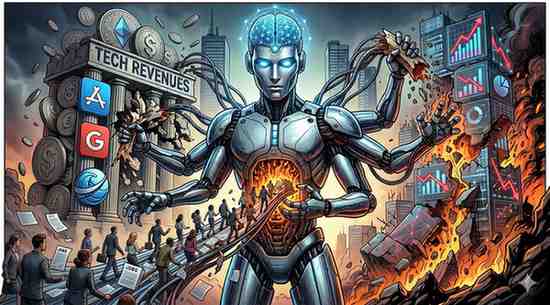
Bengaluru, April 2026 — For years, the narrative surrounding Artificial Intelligence focused on the displacement of the workforce. However, a new and more existential threat has emerged for the tech industry: AI is now cannibalizing the very revenues of the companies that built it.
What was once hailed as a productivity miracle is now forcing India’s IT giants—including TCS, Infosys, and HCL Tech—to confront a “deflationary” reality where faster work leads to smaller paychecks.
From Job Cuts to Revenue Compression
The human cost has already been steep. In early 2026 alone, over 73,000 tech jobs were cut globally due to automation and funding pressures. In India, market leader TCS saw its workforce shrink by over 20,000 in the last financial year.
But the “efficiency” of AI has a double-edged sword: lower human involvement means lower billing rates. Industry leaders are now acknowledging that more AI tools mean fewer billable hours and, ultimately, lower business volumes.
The “AI Discount” Demand
The shift has sparked an awkward conversation in boardrooms: if a task that previously took a team of ten people three months can now be finished by one person and an AI tool in three weeks, why should the client pay the same price?
Major clients are now “hard-coding” AI efficiency discounts of up to 10% directly into their contracts. In a landmark move, KPMG International successfully negotiated a 14% fee reduction from its auditor, Grant Thornton, arguing that technology had made the audit process significantly cheaper and faster.
The Death of “Time and Motion” Billing
To survive, consulting and IT firms are desperately trying to move away from “time and motion” billing—the traditional model of charging based on the hours worked or the size of the team deployed.
The industry is pivoting toward Value-Based Billing, where fees are determined by the outcome or the value generated rather than the effort exerted. However, analysts remain skeptical. Experts believe the industry will undergo significant “self-cannibalization” over the next 24 to 36 months as firms slash prices just to hold onto existing clients.
Software as a Utility?
Even software pricing is shifting fundamentally. Following the vision of “intelligence as a utility,” companies are moving from steady monthly subscriptions to “pay-as-you-go” metered models—similar to how we pay for electricity or water.
While this allows AI companies to charge based on the specific work performed, it makes tech spending increasingly volatile and unpredictable for the customers who rely on these services.
Bottom Line
The era of big-budget, labor-intensive IT projects is dying. As AI automates everything from software bug fixes to tax strategies, the tech industry’s “productivity win” has become its “revenue loss.” The message from global clients is loud and clear: if AI is doing the work, the humans shouldn’t be getting paid for it.
Leave a Reply