
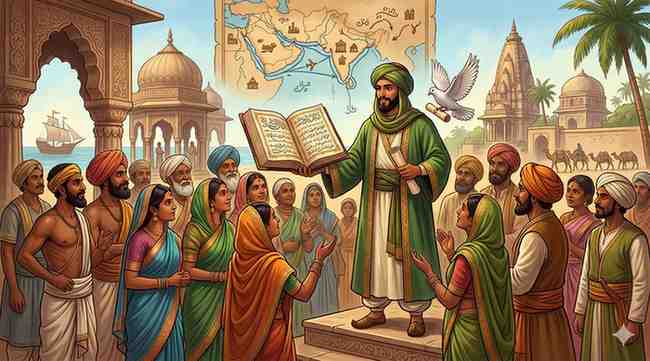
Thiruvananthapuram, April 2026 — Dr. Shashi Tharoor has challenged the prevailing monolithic narrative of Indian history, arguing that the arrival of Islam in South India was a peaceful process of trade and news, rather than the “conquest by the sword” often cited in Northern accounts.
Speaking on the layered complexity of Indian historiography, Dr. Tharoor emphasized that reducing India to a single religious or cultural narrative is not only historically unsound but a fundamental misunderstanding of the nation’s pluralistic identity.
Islam as “News,” Not Conquest
While Northern historical memory often associates the arrival of Islam with Muhammad bin Qasim in 712 AD, Dr. Tharoor highlighted a vastly different experience in Kerala. For over a millennium before the birth of the Prophet, Arab traders had been traveling to the Malabar coast, integrating into local society through trade and marriage [03:46].
“Islam came to us as news,” Tharoor explained. He described how familiar trading partners brought word of a new prophet from the Arabian Peninsula to people they had lived and worked with for centuries [04:15]. This peaceful introduction stands in stark contrast to the narratives of invasion that dominate school textbooks.
The Hindu King and the Prophet
A central figure in this South Indian narrative is the Hindu King Cheruman Perumal. Tharoor recounted how the king was so moved by the teachings of the new prophet that he organized a flotilla to travel to Arabia to meet him [04:34]. Evidence of this historical journey reportedly persists today in Oman, where Kerala coconut trees—taken by the king—continue to grow [05:04].
A Mosque with a Hindu Lamp
The physical manifestation of this pluralism is most evident in the Cheraman Juma Mosque in Kodungallur. Tharoor noted that when the early Muslim community needed a place of worship, the local King, the Zamorin, provided a disused temple [05:27].
Today, the oldest mosque outside the Arab world—dating back to within a few decades of the Prophet’s lifetime—is still famously dominated by an ancient Hindu lamp [05:34]. For Tharoor, this architectural fusion serves as a reminder of a time when multiple identities were accommodated without anxiety.
The Weight of Memory
Tharoor warned that presenting the past as singular and homogeneous forces the modern nation to be imagined in those same exclusionary terms [01:14]. He argued that historiography is central to how we define belonging versus “otherness” in the present day.
“The question is not whether we tell a national story,” Tharoor concluded, “but what kind of story we choose to tell” [02:09]. By remembering these “multiple histories,” he believes India can sustain a common civic life that honors its true, diverse inheritance.
Bottom Line
The arrival of Islam in South India was a story of interaction, not isolation. From Hindu kings visiting Arabia to mosques housing ancient Hindu lamps, the history of the South proves that the “Idea of India” was never a sentimental slogan, but a serious proposition rooted in plurality. With the masks of monolithic history off, the truth remains: those who built our past did so through trade and mutual respect, not just conflict.
Leave a Reply