
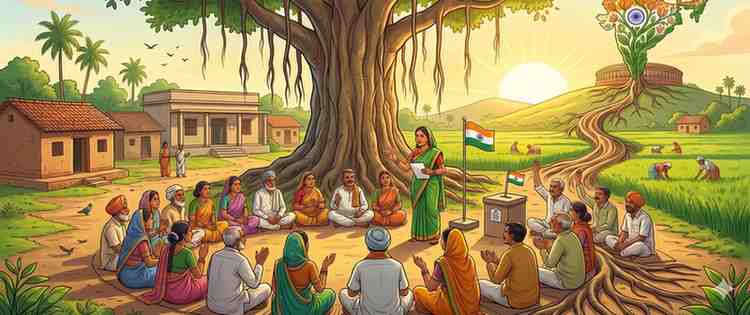
New Delhi, April 2026 — On April 24, India celebrated National Panchayati Raj Day, a significant milestone that honors the decentralization of power and the resilience of local governance. Since the landmark 73rd Constitutional Amendment Act in 1993, the Panchayati Raj system has evolved from a traditional concept into a robust, legally recognized pillar of Indian democracy, bringing decision-making directly to the doorsteps of rural citizens.
A Massive Network of Representatives
India’s rural governance is currently powered by an expansive network of over 2.5 lakh Panchayats. Within this system, roughly 24.04 lakh elected representatives are working to shape the development of their communities.
In a powerful shift toward social equity, nearly half of these elected leaders are women. This surge in female leadership is not just a statistic; it represents a fundamental change in how rural India addresses healthcare, education, and social welfare, ensuring a more empathetic and inclusive governance model.
The Three-Tier Architecture of Growth
The effectiveness of the Panchayati Raj hinges on its three-tier structure:
- Gram Panchayat: The village level, where direct action happens.
- Panchayat Samiti: The intermediate block level.
- Zila Parishad: The district level, ensuring regional coordination.
At the heart of this system is the Gram Sabha, a platform for direct citizen participation. It allows villagers to discuss local issues, audit accounts, and approve development plans, ensuring that accountability remains at the grassroots level rather than being managed by distant bureaucracies.
Inclusion through the PESA Act
To ensure that tribal communities are not left behind, the PESA Act (Provisions on the Panchayats Extension to Scheduled Areas) of 1996 extends these powers to the scheduled areas of 10 states. Covering more than 22,000 Panchayats, this act empowers local tribal bodies to manage their own natural resources and protect their cultural identity, bridging the gap between traditional customs and modern governance.
The Digital Revolution in Villages
The “Digital India” initiative is fundamentally rewriting the rural administrative playbook. Modern tools are replacing slow, manual processes to enhance transparency:
- e-Gram Swaraj: A unified platform for simplified planning and accounting.
- SVAMITVA Scheme: Utilizing drone technology to map village properties, giving rural citizens legal ownership documents and financial leverage.
- Gram Urja Swaraj: A forward-looking project that tracks the adoption of renewable energy, pushing villages toward self-sufficiency.
Bottom Line
National Panchayati Raj Day is a reminder that India’s progress is inextricably linked to the strength of its villages. By combining traditional local wisdom with modern digital tools and inclusive leadership, the nation is ensuring that democracy is not just something practiced in Parliament, but a living, breathing reality for every citizen in the hinterlands. The goal is clear: a self-reliant, sustainable, and empowered rural India by 2047.
Leave a Reply