
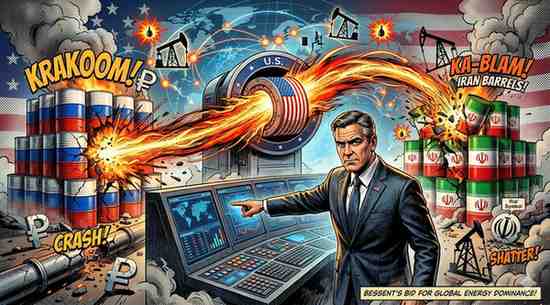
Washington D.C., April 2026 — The United States has officially entered a new phase of economic warfare, terminating oil waivers for Iran and Russia in a strategic move designed to choke off the financial lifelines of both nations.
The announcement, delivered by U.S. Treasury Secretary Scott Bessent, signals the end of “general licenses” that previously allowed certain trade flows. By refusing to renew these waivers, the U.S. is signaling a transition from military posturing to a “Maximum Pressure” economic blockade.
Operation Economic Fury
The centerpiece of this escalation is “Operation Economic Fury,” a Treasury-led initiative aimed at the complete financial isolation of the Iranian state. For over a year, the U.S. has focused on blocking payments and targeting the accounts of the Islamic Revolutionary Guard Corps (IRGC).
Secretary Bessent noted that Iran’s aggressive actions toward its GCC neighbors have backfired, leading those regional partners to become “much more transparent” in assisting the U.S. with deep-dive investigations into Iranian funds held within their banking systems.
Secondary Sanctions: The Financial Kinetic Strike
The U.S. is no longer just targeting the sellers; it is going after the buyers and their bankers. Secondary sanctions—the most severe tool in the Treasury’s arsenal—are now being actively deployed.
- The Ultimatum: Any country purchasing Iranian oil or holding Iranian money in its banks faces immediate exclusion from the U.S. financial system.
- The Warning to China: The Treasury has already issued formal letters to two major Chinese banks. The message was explicit: if proof emerges of Iranian money flowing through their accounts, they will face the full weight of secondary sanctions.
A $40 Billion Insurance Shield
To prevent a total collapse of global shipping or a massive spike in energy costs, the U.S. is launching a $40 billion reinsurance program through the Development Finance Corporation (DFC).
This move is designed to stabilize the “skyrocketing” insurance rates seen at Lloyd’s of London. By providing a government-backed alternative, the U.S. intends to offer an economically sound basis for shipping companies to continue moving through the Gulf once routes are declared safe, effectively taking the profit away from war-risk insurers while maintaining supply-line normality.
Domestic Relief and “America First” Tactics
Parallel to the foreign policy shift, the administration is touting domestic tax reforms—including “no tax on tips” and overtime exemptions—as a way to buffer American workers against global volatility. Officials argue that while gas prices remain a concern, putting more money directly into the pockets of 53 million working-class Americans is the ultimate “home run” for the economy.
Bottom Line
The era of “oil waivers” and diplomatic leniency is over. By treating financial sanctions as the “equivalent of kinetic activities,” the U.S. has made it clear that the global oil trade must now choose sides. With the straits under a virtual blockade and secondary sanctions looming over international banks, the U.S. is banking on an economic victory where military intervention was once the only option.
Leave a Reply