
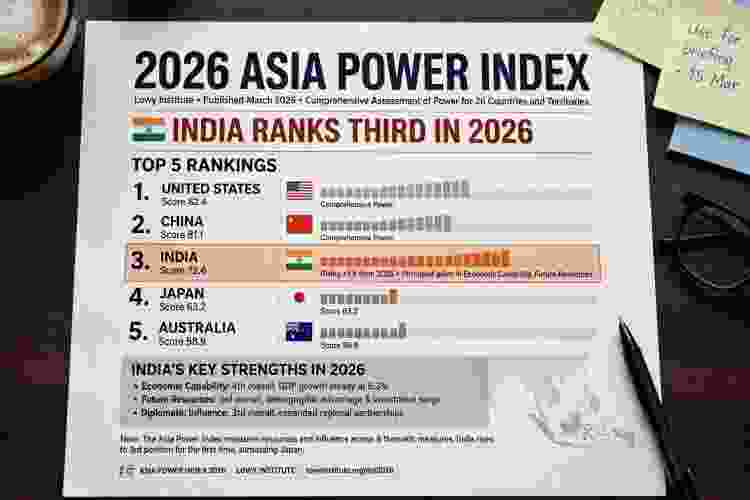
New Delhi, November 2026 — India has claimed third place in the Lowy Institute’s 2026 Asia Power Index, cementing its status as a major regional force. While the ranking confirms New Delhi’s growing clout across the Asia-Pacific, the numbers beneath the headline tell a tougher story: a wide gulf still separates India from the top two.
A Two-Horse Race at the Top
Evaluating 27 countries and territories across 131 indicators and eight dimensions of power, the Sydney-based think tank classifies the United States (78.9) and China (73.6) as the region’s only “comprehensive powers”.
India sits in third place with a score of 40.5, edging up marginally from 40 in the previous edition. Although New Delhi has chipped away at its 2018 gap with Beijing, China still commands over 80% more comprehensive power—anchored by manufacturing dominance, maritime reach, rapid military modernization, and the Belt and Road Initiative.
High Potential, Negative Yield
A closer look at the eight parameters reveals where India shines and where it stalls:
- Strengths: India scores well in future resources (56.2, rank 3) and resilience against external shocks (55.4, rank 4), backed by solid military capability (48.5) and cultural influence (43.8).
- Weaknesses: Low per capita income pulls economic capability down to 26.4, while economic relationships (19.9) and defense networks (18.6) remain glaring gaps.
The result is a “power yield” of -3.3. In plain terms, India is punching below its weight—possessing substantial resources, yet struggling to convert that potential into real regional influence.
Modi’s Leadership: Regional Clout, Global Test
In the leadership rankings, Prime Minister Narendra Modi placed second in Asia, trailing only Chinese President Xi Jinping. Twelve years of policy continuity, political stability, vocal advocacy for the Global South, and External Affairs Minister S. Jaishankar’s assertive diplomacy have sharpened India’s regional standing.
Yet perceptions of Modi as a global leader dipped slightly. The US-Iran Gulf conflict tested India’s multi-alignment strategy—most starkly when the United States sank an Iranian naval vessel in the Indian Ocean as it returned from an exercise in India, drawing sharp criticism over New Delhi’s diplomatic leverage.
Turning Potential Into Power
Military hardware alone will not close the gap with Beijing. The roadmap ahead rests on five fronts: deepening ASEAN ties, scaling defense exports like BrahMos missiles, protecting strategic autonomy, building manufacturing and semiconductor capacity, and skilling India’s young workforce. Until its resources translate into deeper influence, third place remains both a milestone and a reminder of unfinished work.
Leave a Reply