
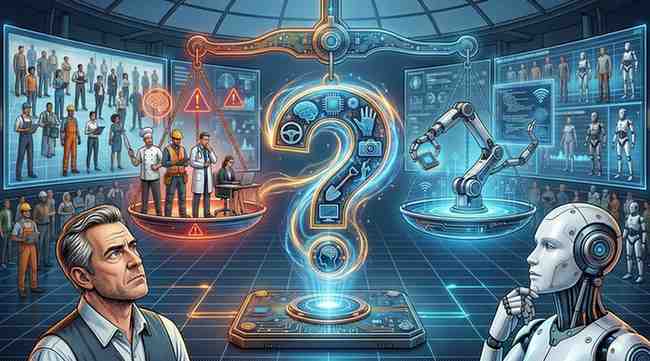
NEW DELHI, March 2026 — As artificial intelligence continues its rapid integration into the global workforce, Anthropic—the creator of the Claude AI—has released a rigorous labor market study. The report introduces a new measure for understanding which roles are most vulnerable to automation and, more importantly, which ones remain insulated by the necessity of human touch.
The “Safe” Zone: Physical and In-Person Roles
According to the study, the most secure jobs are those anchored in the physical world. Roles requiring manual dexterity, real-world judgment, and direct human interaction remain the least vulnerable to AI replacement.
The “Safe List” includes:
- Service & Maintenance: Cooks, bartenders, motorcycle mechanics, and groundskeepers.
- Safety & Care: Lifeguards and personal care providers.
- Soft Skills: While digital tasks can be automated, jobs involving physical interviews, real-world networking, and complex interpersonal judgment cannot easily be replicated by current systems.
The High-Exposure List: White-Collar Vulnerability
The study differentiates between “theoretical capability” and “practical usage.” While AI could theoretically handle 94% of tasks for math and computer workers, it currently covers only 33% in professional settings. However, the “exposure” levels for certain white-collar roles are significant:
- Computer Programmers: 75% of tasks are theoretically automatable.
- Customer Service & Data Entry: 70% and 67% exposure respectively.
- Financial & Market Analysts: Exposure ranges from 57% to 65%.
- Healthcare Admin: Medical records specialists face 67% task exposure.
The “Front Door” is Closing for Gen Z
While the research found little evidence that AI has triggered immediate, large-scale layoffs, it highlighted a disturbing trend for younger workers. Companies are not necessarily “firing” existing staff, but they are “closing the front door” on new talent.
Entry into high-exposure occupations for workers aged 22 to 25 has plummeted by 14% since late 2022. This shift suggests that entry-level tasks, often used to train junior staff, are being the first to be offloaded to AI tools.
Bottom Line
Anthropic clarifies that “exposure” does not equate to the total disappearance of a job. Instead, it signals a massive shift where a majority of tasks will be supported or handled by AI. For sectors like India’s IT services, which recently faced a major market sell-off over AI obsolescence risks, the message is clear: evolve quickly or risk being left behind in the “post-hype” reality.
Leave a Reply