
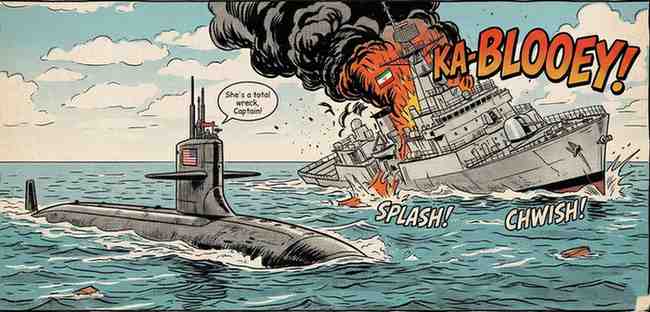
COLOMBO, March 2026 — A dramatic maritime strike has shifted the geography of the Middle East conflict into the Indian Ocean. In a rare and lethal underwater operation, a United States Navy submarine intercepted and sank the Iranian frigate IRIS Dena off the southern coast of Sri Lanka.
The attack, occurring just 40 nautical miles from the port of Galle, marks a significant escalation as the war spills over from the Persian Gulf into neutral international waters.
A Rare Torpedo Strike in the 21st Century
While modern naval warfare is typically defined by long-range missiles and drone swarms, this engagement saw the U.S. deploy a submarine-launched torpedo. The IRIS Dena—one of Iran’s most modern, domestically built warships—was struck with such precision that it reportedly lost all power instantly before plunging into the depths.
Military historians note this is the first time since World War II that a U.S. submarine has successfully neutralized an enemy surface warship in active combat. The strike sends a chilling message regarding the reach and stealth of American underwater capabilities.
The India Connection: A Diplomatic Nightmare
What makes the sinking particularly sensitive is the IRIS Dena’s recent itinerary. The warship was returning to Iran after a high-profile visit to India, where it had participated in the Milan Naval Exercise and the International Fleet Review 2026 in Visakhapatnam.
During these events, the Iranian vessel shared the harbor with navies from 75 nations—including the United States. The decision to sink the ship so shortly after it left Indian waters creates a complex diplomatic challenge for New Delhi, which has been attempting to balance its strategic ties with both Washington and Tehran.
Casualties and the Rescue Effort
The aftermath of the explosion was catastrophic. Of the 180 crew members on board:
- 87 fatalities have been confirmed as bodies were recovered from the site.
- 32 sailors were rescued by the Sri Lankan Navy following a frantic distress signal.
- 61 personnel remain missing, with search operations hampered by the depth of the Indian Ocean at the strike location.
Survivors were transported to hospitals in Galle, while the Sri Lankan government remains on high alert as its territorial waters become a backdrop for superpower friction.
Justification and Expansion of the War Zone
The U.S. has defended the strike as a “legitimate military action,” characterizing the IRIS Dena as a tool for Iranian power projection. Following the recent death of Iran’s Supreme Leader and subsequent Iranian strikes on British assets in Cyprus, Washington appears determined to dismantle Iran’s naval reach piece by piece.
Critics argue that by targeting a ship in the Indian Ocean, the U.S. has effectively expanded the “Middle East War” into a global maritime conflict. For India and Sri Lanka, the message is clear: the safety of the Indian Ocean can no longer be taken for granted.
Bottom Line
The sinking of the IRIS Dena is more than just a loss of hardware for Tehran; it is a psychological blow delivered from the shadows of the ocean. As the war expands, the waters south of India have transformed from a zone of diplomatic cooperation into a frontline of high-stakes military elimination.
Leave a Reply