
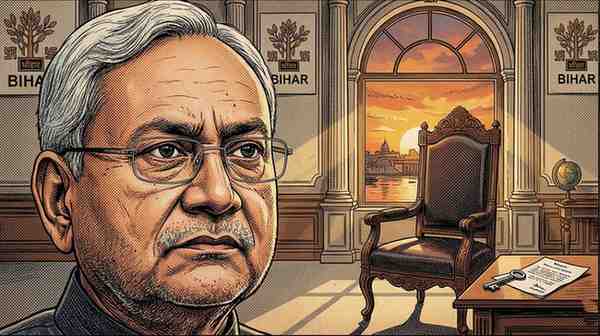
PATNA, March 2026 — Bihar’s political landscape is set for a historic transformation as Nitish Kumar, the state’s longest-serving Chief Minister, prepares to step down. Confirming long-standing rumors, Kumar announced his intention to exit state leadership to file a nomination for the Rajya Sabha.
Known as the architect of modern Bihar, his departure signals a massive power shift within the National Democratic Alliance (NDA) and the end of a two-decade-long “Nitish Era.”
The Legacy of “Sushasan Babu”
Nitish Kumar earned the title “Sushasan Babu” (Governance Man) for pulling Bihar out of the “Jungle Raj” era—a period before 2005 marked by high crime and collapsing infrastructure. Over his ten terms as Chief Minister, he implemented several landmark reforms:
- Law & Order: He introduced fast-track courts to convict thousands of criminals, restoring public safety.
- Infrastructure: His tenure saw a massive expansion of rural roads, highways, and bridges that connected the remotest parts of the state.
- Social Engineering: He pioneered 50% reservation for women in Panchayats and launched the “Cycle Yojana,” which revolutionized female education by providing free bicycles to schoolgirls.
The “Palturam” Tag: A Master of Alliances
While his governance was praised, Kumar’s political journey was defined by strategic—and often controversial—alliance switching. Since 2005, he pivoted between the BJP and the RJD-Congress “Mahagathbandhan” multiple times to maintain his hold on power. This unpredictable nature earned him the nickname “Palturam”, as he balanced ideological shifts with political survival.
The Transition to National Politics
At 75, Kumar’s move to the Rajya Sabha is seen as a way to remain politically active while stepping away from the grueling day-to-day administration of a state with over 130 million people. By moving to the center, he completes a rare parliamentary “grand slam,” having served as an MP, a Union Minister, a Chief Minister, and now a member of the upper house.
The Power Shift: A BJP Chief Minister?
Kumar’s resignation opens the door for the BJP to take the lead in Bihar. Currently, the BJP holds 89 seats compared to JDU’s 85 in the assembly. Speculation is rife that the next Chief Minister will come from the BJP, with names like Samrat Choudhary and Vijay Kumar Sinha at the forefront. This transition allows the BJP to establish total dominance in the state, potentially leaving the future of the JDU in question.
Bottom Line
The era of Nitish Kumar in Patna was about transitioning Bihar from a state of chaos to a state of aspiration. As he heads to New Delhi, he leaves behind a Bihar that is vastly different from the one he inherited in 2005. The “Sushasan Babu” chapter is closing, and Bihar now braces for a new generation of leadership under the lotus banner.
Leave a Reply