
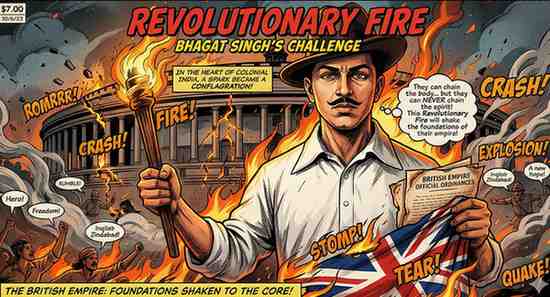
Lahore, March 1931 — The British Empire has long feared the power of an idea, but today they face the indomitable spirit of a man. Bhagat Singh, the 23-year-old revolutionary who became the face of India’s resistance, has transitioned from a prisoner of the Crown to an eternal icon of the freedom struggle.
While the British intended for his execution to be a quiet end to a “troublemaker,” they have instead ignited a nationwide firestorm. As the saying goes, they can hang a revolutionary, but they cannot hang the revolution.
A Childhood Rooted in Rebellion
Born in 1907 to a family of freedom fighters, Bhagat Singh’s defiance was evident from his earliest years. A famous anecdote from his childhood recalls him “planting” a toy gun in the soil, telling his father he was growing a crop of weapons to drive the British out.
His path was irrevocably altered on April 13, 1919. At just 12 years old, Singh walked miles to reach the site of the Jallianwala Bagh massacre. Standing amidst the carnage, he collected blood-soaked earth in a bottle—a grim souvenir that served as his lifelong vow to dismantle British rule.
The Shift from Non-Violence to Revolution
Initially a follower of Mahatma Gandhi, Singh’s faith in non-violence shattered following the withdrawal of the Non-Cooperation Movement in 1922. He realized that “peaceful tactics” alone would not bend the iron will of the Empire.
- The HSRA: Alongside Chandrashekhar Azad, he helped form the Hindustan Socialist Republican Association, merging socialist ideals with revolutionary action.
- A Debt of Honor: After the death of his mentor, Lala Lajpat Rai, following a brutal police lathi charge, Singh and his comrades executed a plan to assassinate the officer responsible, James Scott—though they mistakenly killed Deputy Superintendent J.P. Saunders instead.
“To Make the Deaf Hear”
On April 8, 1929, Singh and Batukeshwar Dutt staged a daring protest by throwing low-intensity bombs into the Central Legislative Assembly in Delhi.
- The Goal: The explosion was not intended to kill, but to draw global attention to the repressive Public Safety and Trade Dispute Bills.
- The Arrest: Rather than fleeing through the smoke, Singh stood his ground, shouting “Inquilab Zindabad” (Long Live Revolution) and voluntarily surrendering to use the courtroom as a platform for his ideology.
The Final Sacrifice
Even behind bars, Singh remained a threat to British stability. He led a historic 64-day hunger strike to demand better rights for political prisoners, captivating the Indian public.
Fearful of a massive uprising scheduled for his official execution date of March 24, 1931, the British moved the hanging forward by eleven hours. On the evening of March 23, 1931, Bhagat Singh, alongside Rajguru and Sukhdev, kissed the gallows with a smile.
Bottom Line
Bhagat Singh’s life was short, but his impact was seismic. He famously refused to have his face covered or his hands tied during the execution, facing death with the same courage he showed in life. Today, he remains not just a martyr, but a symbol of the intellectual and militant fire that eventually forced the British Empire to its knees.
Leave a Reply