
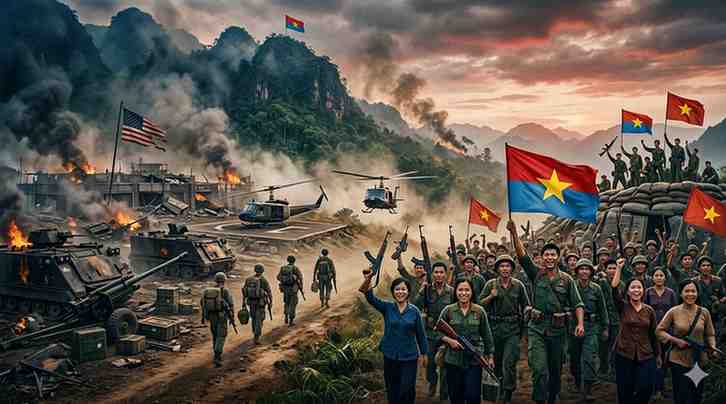
Hanoi, April 1, 2026 — The Vietnam War stands as a definitive moment in modern history, representing the first time the United States’ claim to superpower invincibility was fundamentally broken. For 20 years, from 1955 to 1975, the U.S. poured billions of dollars and millions of troops into a conflict it ultimately could not win.
What began as a struggle for independence from French colonial rule ended as a humiliating retreat for the U.S. and a unified victory for the communist North.
Roots of Resistance: From French Colonies to Cold War
The conflict’s roots trace back to 1887 under the French colonial system. By the 1940s, nationalist leader Ho Chi Minh emerged as the face of resistance. After the 1954 defeat of the French at Dien Bien Phu, the Geneva Accords split the nation into the communist North and U.S.-backed South.
The U.S. entered under the “Domino Theory”—the belief that if Vietnam fell to communism, the rest of Southeast Asia would follow. This policy drove American involvement for the next two decades.
Chemical Warfare and the Guerrilla Trap
By 1965, U.S. Marines had entered the war as active combatants. Facing an elusive enemy in the Viet Cong, the U.S. turned to controversial tactics, including Operation Ranch Hand.
Under this operation, the U.S. sprayed Agent Orange, a toxic chemical herbicide, over rural fields and forests. The goal was to destroy vegetation and strip away the cover used by guerrilla fighters. Instead, it caused lasting ecological damage and health crises for both locals and soldiers that persist even today.
The Tet Offensive: Shifting the Narrative
The 1968 Tet Offensive was the war’s psychological turning point. While a military victory for the U.S., the sheer scale of the North’s surprise attacks on 100 cities—including the U.S. Embassy—shattered the American public’s belief that the war was nearly over.
The release of the Pentagon Papers in 1971 further fueled domestic anger, revealing that the government had secretly expanded the war while publicly claiming to scale it back. By 1973, under President Richard Nixon, the Paris Peace Accords were signed, leading to a total U.S. withdrawal.
Why the U.S. Lost: The Impossible Victory
Military strategists and historians highlight several reasons why the world’s most powerful military failed:
- Lack of Conviction in the South: The South Vietnamese government was plagued by corruption and favoritism, failing to gain the popular support of its own people.
- Guerrilla Prowess: The North successfully framed the war as a nationalist struggle against “imperialist” invaders, turning local civilians into allies who hid fighters in plain sight.
- Superpower Support: The North was never alone; it received consistent military and economic aid from the USSR and China.
- Domestic Collapse: Massive anti-war protests in the U.S. and the repeal of the Gulf of Tonkin Resolution by Congress eventually made it politically impossible to continue the fight.
Bottom Line
The Vietnam War ended in July 1975 when Saigon fell and the country united as a Socialist Republic. It claimed 58,000 American lives and millions of Vietnamese lives. The “Lost Victory” was never about a lack of firepower; it was a failure to realize that military might cannot conquer a population that views the invader as a greater threat than the ideology they are fighting against.
Leave a Reply