
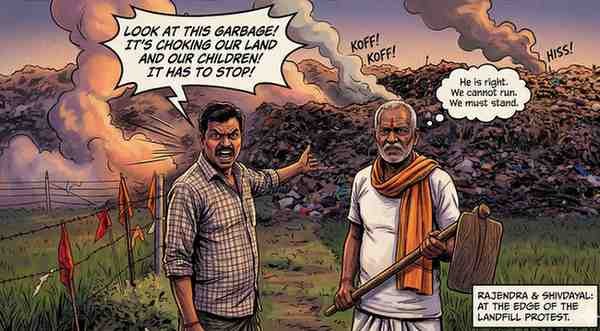
Ghaziabad, March 2026 — Less than 20 kilometers from the heart of New Delhi, the village of Mirpur Hindu has become the epicenter of a desperate struggle. For over two months, farmers from this village and 16 surrounding hamlets have stood their ground against a massive solid waste management plant, a project they believe will transform their fertile fields into a toxic wasteland.
The 15th February Clash: Violence and Betrayal
The standoff reached a breaking point a few weeks ago when local protests were met with a heavy police presence. Farmers allege that a brutal lathi charge left several protesters, including the elderly, with fractured limbs. “They treated us like we were from Pakistan,” one farmer remarked, describing the shock of being “hunted” through their own fields by police.
While the ASP of Loni officially denies that a lathi charge occurred—claiming instead that farmers initiated stone-pelting—the victims tell a different story of being cornered and beaten while attempting to offer a peaceful, symbolic arrest.
A “Bait and Switch” on Development
The anger in Mirpur Hindu is fueled by what residents call a “lie” by the administration. Initially, when the 8.2-hectare site was cordoned off, authorities reportedly told the villagers that the land was earmarked for a degree college, a hospital, or a first-aid center—facilities the region desperately lacks.
Instead, a waste management plant capable of handling 1,600 to 2,000 metric tons of garbage per day was erected. “If this is such a good thing for development, why are you bringing the city’s filth to our doorstep?” a local youth questioned.
The Environmental Threat: Water and Air at Risk
The plant sits on government land with a dangerously high water table—just 20 feet below the surface. For a village that relied on its pure water and clean air to stay COVID-free during the pandemic, the dumpyard feels like a death sentence.
Residents fear that “leachate”—the toxic liquid that drains from landfills—will seep into the groundwater, poisoning the very water they drink and use for irrigation.
“This isn’t just a dumpyard; it’s a poison for our future. Our children’s lives are being traded for the city’s convenience,” a local resident stated.
The “Indore Alternative”
The conflict highlights a deeper systemic failure. While cities like Indore have successfully managed waste through 100% source segregation and scientific processing without creating massive environmental hazards, the Ghaziabad model appears to rely on dumping waste in rural “buffer zones”.
The plant stands just 150 meters from local temples and 200 meters from residential homes, violating what farmers claim should be a 3-kilometer exclusion zone for such facilities.
Bottom Line
The battle in Mirpur Hindu is more than a protest against trash; it is a fight for the right to a healthy environment. As a joint committee begins a probe into the plant’s legality, the farmers remain clear: they would rather die protecting their land than live to see it destroyed. The question remains—can urban “solutions” ever be considered progress if they leave the rural heartland behind?
Leave a Reply