
London/Washington D.C., March 2026 — Global markets and political circles are reeling from explosive allegations of insider trading tied to President Donald Trump’s recent military and diplomatic announcements. A UK Member of Parliament has publicly branded the situation “corruption of the very worst kind,” suggesting that the President may be leaking sensitive war-related information to enrich “his mates”.
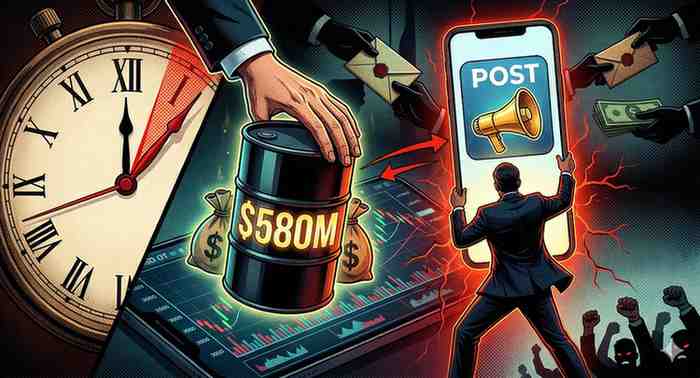
The controversy centers on a Financial Times report detailing a series of perfectly timed trades valued at approximately $580 million on Monday, March 23rd.
The “Golden 15 Minutes”
At 6:50 a.m. New York time—a typically quiet pre-market window—traders made “extraordinary moves,” selling oil futures and buying S&P 500 futures in volumes four to six times larger than normal.
Exactly 15 minutes later, at 7:05 a.m., President Trump posted an announcement on Truth Social claiming productive negotiations with Iran. Within minutes, oil prices plunged 14% while stock futures surged 2.5%, netting whoever placed the bets massive profits almost instantly.
“Fake News” and Market Manipulation?
The credibility of the announcement itself has been thrown into doubt. Iranian Parliament Speaker Mohammad Bagher Ghalibaf dismissed Trump’s claims of negotiations as “fake news” designed specifically to manipulate financial and oil markets. Iran’s foreign ministry further clarified that no negotiations had occurred, directly or through intermediaries, raising questions about whether the “supposed negotiations” were a fabrication used to trigger market movement.
A Pattern of Suspicious Timing
Market analysts and political critics point out that this is not an isolated incident. Similar “unusually precise” betting activity preceded other major announcements, including the death of Iran’s Supreme Leader and the capture of Venezuela’s President Maduro.
On the prediction platform Polymarket, eight newly created accounts reportedly bet nearly $70,000 on an Iran ceasefire just moments before the President’s post. While the White House has dismissed the allegations as “baseless,” the U.S. Securities and Exchange Commission (SEC) has notably declined to comment on whether an investigation is underway.
Bottom Line
As energy bills in the UK and elsewhere threaten to climb by hundreds of pounds due to the ongoing conflict, the focus has shifted from the battlefield to the trading floor. The central question remains: was $580 million in profit the result of a lucky guess, or was it the product of advanced information leaked from the highest levels of government?.
Leave a Reply