
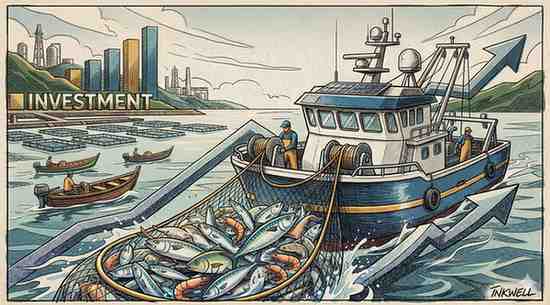
New Delhi, April 2026 — India’s fisheries sector has officially transitioned from a traditional allied activity into a global powerhouse. Emerging as the world’s second-largest fish producer, India now accounts for roughly 8% of global production, signaling a major shift in the nation’s economic and nutritional landscape.
The Surge: Doubling Production in a Decade
The numbers tell a story of rapid, sustained growth. Over the last ten years, focused government interventions have pushed fish production to nearly 198 lakh tonnes—more than double the output of the previous decade.
To maintain this momentum, the Union Budget 2026 has allocated a historic ₹2,761.80 crore to the sector. This record-breaking investment is designed to transition the industry from quantity-based growth to a value-driven ecosystem under the flagship Pradhan Mantri Matsya Sampada Yojana (PMMSY).
Empowering the Grassroots: Financial & Social Inclusion
The growth isn’t just in the water; it’s in the lives of the fishermen. The government has prioritized the financial stability of the community through several key initiatives:
- Credit Access: More than 4.3 lakh fishermen have been brought into the formal economy through the Kisan Credit Card (KCC) scheme, providing them with essential working capital.
- Safety Nets: In an industry fraught with physical risk, 33 lakh beneficiaries are now covered under insurance schemes, offering a vital security layer for their families.
- Direct Support: Over 7 lakh fishing families have received direct livelihood assistance, ensuring that the benefits of the “Blue Revolution” reach the most vulnerable households.
The Tech Leap: Biofloc and Recirculatory Systems
The future of Indian fisheries is moving inland and into high-tech setups. To solve the challenges of water scarcity and land use, the industry is heavily investing in:
- RAS (Recirculatory Aquaculture Systems): Allowing for high-density farming with minimal water waste.
- Biofloc Technology: A sustainable method that converts waste into feed, reducing costs and environmental impact.
- Digital Integration: New digital platforms are being deployed to ensure transparent administration, real-time monitoring of yields, and better price discovery for the producers.
A Competitive Edge on the Global Stage
By combining massive infrastructure upgrades with modern aquaculture techniques, India is aiming to make its exports more competitive in international markets. The focus has shifted toward building a robust value chain—from cold storage and processing units to high-tech hatcheries.
Bottom Line
India’s fisheries sector is no longer just a source of food; it is a sophisticated economic engine. With record-high budgetary support and a focus on both technological modernization and social equity, the “Blue Revolution” is set to ensure that India remains a dominant force in the global seafood market while securing the livelihoods of millions.
Leave a Reply