
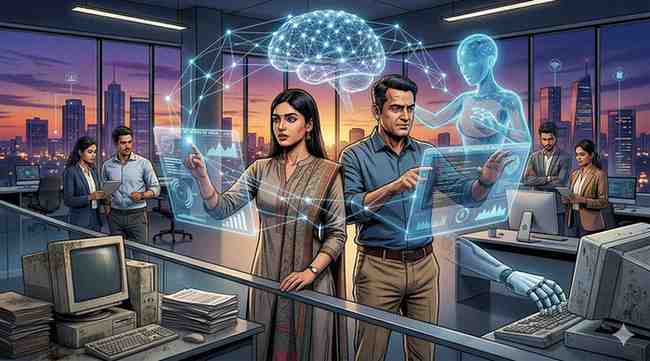
Artificial intelligence is rapidly transforming India’s job market, forcing millions of professionals to rethink their career strategies. Experts now recommend building an ‘AI survival toolkit’ combining technical upskilling, human-centric skills, and adaptability to remain employable in the evolving economy.
New Delhi, April 2026 — A staggering 65% of Indian IT professionals fear their current skills will become obsolete within three years, according to a recent NASSCOM survey, as artificial intelligence tools increasingly automate tasks once considered safe from technological disruption.
What Is Happening?
India’s workforce is facing an unprecedented skills crisis as AI adoption accelerates across industries. From content writing to coding, customer service to data analysis, automation is reshaping job descriptions faster than training programs can adapt. The conversation has shifted from whether AI will impact jobs to how quickly workers must evolve.
Why Is This Important for Common Indians?
This disruption affects everyone from fresh graduates entering the job market to mid-career professionals supporting families. Young Indians investing lakhs in traditional degrees may find their qualifications insufficient without AI fluency. The middle class, which depends heavily on service sector employment, faces particular vulnerability as routine cognitive tasks get automated.
What Do Experts Say?
Industry leaders emphasise that survival requires a dual strategy. Workers must learn to collaborate with AI tools rather than compete against them. Soft skills like critical thinking, emotional intelligence, and creative problem-solving are becoming more valuable precisely because machines cannot replicate them effectively.
- McKinsey estimates 23% of work hours in India could be automated by 2030
- AI-related job postings in India grew 42% year-on-year in early 2026
- Average reskilling investment needed per worker: ₹50,000-₹1,50,000
- Top demanded skills: prompt engineering, AI tool management, data literacy
- Government’s Skill India Digital Hub reports 3 crore new registrations since January
What Should You Expect Next?
Companies are increasingly hiring for hybrid roles that combine domain expertise with AI proficiency. Remote work opportunities are expanding as location becomes less relevant than capability. Those who adapt early will likely command premium salaries while late movers risk prolonged unemployment.
The impact touches every household. A Bengaluru software engineer must now master AI pair-programming. A Delhi journalism student needs to understand AI-assisted reporting. A Mumbai finance professional requires AI-driven analytics skills. Even teachers, doctors, and lawyers face pressure to integrate these technologies into their practice.
आगे क्या? (What’s Next)
The coming months will prove decisive for India’s workforce transformation. Government initiatives like Digital India and Skill India are scaling up AI training modules, but individual initiative remains crucial. Professionals who build their survival toolkit now—combining technical AI skills with irreplaceable human capabilities—will thrive in this new economy. Those waiting for the disruption to pass may find themselves permanently left behind. The message is clear: adapt today or struggle tomorrow.
Leave a Reply