
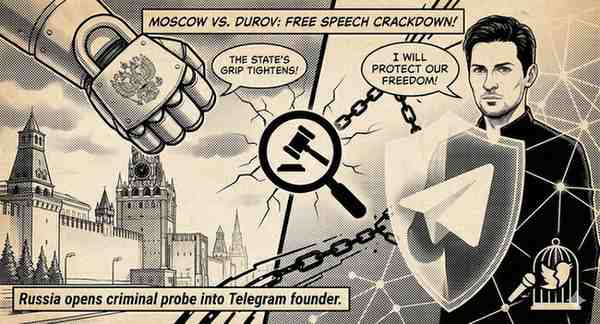
Moscow, February 2026 — Russia has officially opened a criminal investigation into Pavel Durov, the billionaire founder of Telegram, accusing him of aiding terrorism in a move that signals the end of digital privacy within the country.
What the Russian government calls a necessary strike against “national security threats,” Durov describes as a “sad spectacle” of a state terrified of its own people. The probe marks the final collapse of the relationship between the tech mogul and his home country.
A Fabricated Charge of Terrorism
The investigation, led by the Federal Security Service (FSB), centers on allegations that Telegram has become a hub for illicit activities and terrorism by refusing to grant the state access to user communications.
This move follows a recent decision by Russia’s communications watchdog, Roskomnadzor, to restrict the app entirely. Kremlin spokesperson Dmitry Peskov stated that the FSB has compiled a “large number of violations” involving content that poses a “danger to the country”. Durov, however, maintains that these charges are fabricated to justify the suppression of free speech.
The Military Paradox
The crackdown has created a unique crisis for the Russian military. For years, Telegram has been the primary tool for coordination among Russian troops fighting in Ukraine. By moving to criminalize the platform and its founder, Moscow risks “blinding” its own front-line soldiers.
To bridge this gap, the government is warning troops that foreign intelligence agencies are intercepting their Telegram messages, urging a shift to state-monitored alternatives.
The Rise of “Max”: Surveillance as a Service
As Telegram is pushed out, the Kremlin is aggressively promoting “Max,” a state-developed “all-in-one” app for messaging and government services.
Unlike Telegram’s commitment to privacy, Max is built for surveillance:
- No end-to-end encryption: Experts warn the app lacks basic security for private users.
- Open Data Sharing: The platform explicitly states it will hand over all user data to authorities upon request.
A History of Defiance
This is not Durov’s first flight from Russian authority. In 2014, he was forced out of VKontakte (VK), the social network he founded, after refusing to hand over data on Ukrainian opposition figures to the Kremlin.
He sold his shares for €300 million and left Russia, vowing never to return. He launched Telegram from Dubai as a beacon of independence, but even there, he has faced global pressure, including a 2024 arrest in Paris over the platform’s alleged use in illicit trafficking.
Bottom Line
The investigation into Pavel Durov is more than a legal case; it is the closing of the Russian internet. By labeling the world’s most popular “privacy-first” app as a tool for terrorism, the Kremlin is making it clear: in Russia, there is no longer a middle ground between total state surveillance and criminal activity.
Leave a Reply