
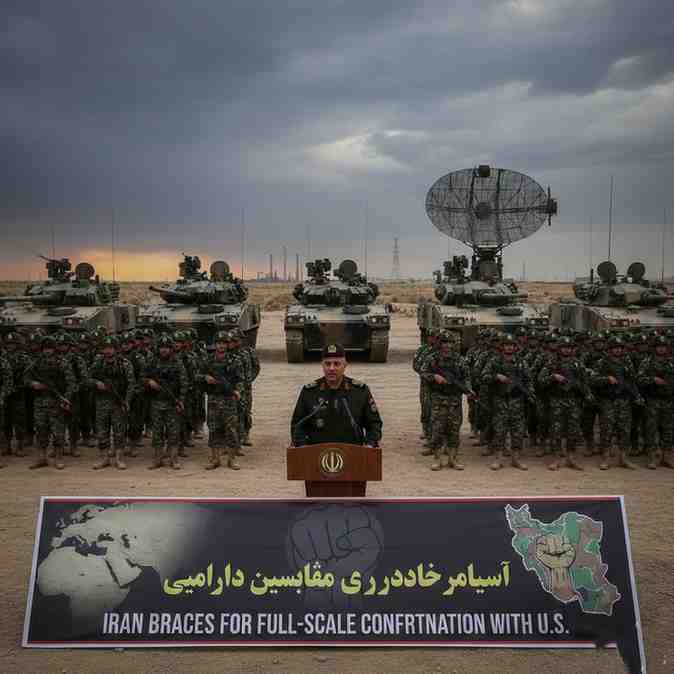
Tehran, February 2026 — The drums of war are beating louder than ever in the Middle East. As diplomatic channels in Geneva and Oman hit a dead end, fresh intelligence reveals that Iran has shifted into a “full war mode.” What was once a shadow play of threats has transformed into a concrete preparation for a high-stakes showdown with the United States, as Tehran fortifies its nuclear heartlands and mobilizes its strike capabilities.
Fortifying the “Unstrikable”: The Concrete Shield Satellite imagery captured by the Institute for Science and International Security on February 16 has sent shockwaves through Western intelligence circles. At the Parchin military complex, Iran has constructed a massive concrete roof designed to neutralize bunker-busting bombs and aerial strikes.
This isn’t just about protection; it’s about persistence. At sites in Isfahan and Natanz, tunnel entrances previously damaged in 2025 strikes have been backfilled with earth and reinforced. Intelligence suggests Iran is moving its enrichment capabilities deeper underground into “secret tunnels” that are virtually unreachable by conventional air power.
Posturing for the Strait: “Bottom of the Sea” On the water, the rhetoric has turned lethal. Following military drills on February 16, the Revolutionary Guards released footage of a mock enemy ship being decimated by Iranian missiles. The message to the U.S. Navy was unmistakable: any attempt to intervene will result in the closure of the Strait of Hormuz.
The stakes were raised further on February 19, when Iran and Russia held joint naval exercises in the Sea of Oman—deliberately positioned near the USS Abraham Lincoln carrier strike group. Supreme Leader Ayatollah Khamenei underscored the tension on February 17, chillingly vowing to send American warships to the “bottom of the sea” if Iranian sovereignty is breached.
Domestic Lockdown: A Regime Under Pressure Behind the military bravado lies a regime deeply rattled by internal dissent. Following the massive anti-government protests that ended in January 2026, Tehran has been transformed into a surveillance fortress.
- 100 Monitoring Points: Established across the capital to crush any sign of a fresh uprising.
- The 53,000 Detained: Human rights groups report a staggering number of arrests as the IRGC sweeps up dissidents to ensure “internal stability” during a potential war.
- Foreign Scapegoating: Officials continue to blame the U.S. and Israel for domestic unrest, using it as a pretext for a sweeping crackdown.
The Failed Handshake Despite the high-profile nature of indirect talks in Oman and Geneva, sources confirm that both rounds failed to yield a breakthrough. With the U.S. reportedly prepared to initiate strikes as early as February 21, the window for a handshake has all but slammed shut.
Bottom Line Tehran is no longer just talking about deterrence; it is building for survival. From buried nuclear labs to “ship-killer” missiles and a domestic iron fist, Iran is signaling that it is ready to risk a full-scale conflagration rather than blink first at the negotiating table.
Leave a Reply