
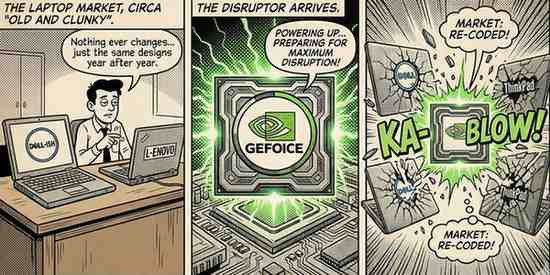
SANTA CLARA, February 2026 — In a strategic move that could upend the traditional hierarchy of the PC market, NVIDIA is reportedly preparing a massive return to consumer computing. According to reports from the Wall Street Journal, the tech giant is no longer content with just dominating the graphics card market; it is now engineering its own processors to power a new generation of laptops.
With heavyweights like Dell and Lenovo already preparing models, NVIDIA’s entry signals a direct challenge to the decades-long dominance of Intel and AMD.
The Two-Pronged Attack: ARM and x86
NVIDIA is covering all bases by developing two parallel chip architectures to ensure maximum market penetration:
- The ARM Revolution: In a high-stakes partnership with MediaTek, NVIDIA is building a System-on-a-Chip (SoC) based on ARM architecture. Similar to Apple’s M-series, this chip integrates the CPU, graphics, and AI into one efficient slice of silicon, aiming for the “thin and light” crown.
- The x86 Hybrid: Simultaneously, NVIDIA is collaborating with Intel to pair Intel’s traditional x86 CPUs with NVIDIA’s industry-leading graphics and AI cores.
By betting on both futures, NVIDIA aims to deliver what CEO Jensen Huang describes as “low power but very powerful” devices—laptops that last all day but still pack a punch.
Ending the “Dedicated GPU” Requirement
Historically, if a user wanted serious performance for gaming or creative work, they had to buy a bulky laptop with a separate, power-hungry graphics card. NVIDIA’s internal projects—codenamed N1 and N1X—aim to change that.
The goal is to bake “monster” graphical power directly into the main processor. While these initial chips are targeted at ultra-portables, they represent a significant step toward a future where “integrated graphics” are no longer a compromise, but a feature.
The Software Hurdle: Can It Run Windows?
The biggest ghost haunting this project is the legacy of ARM-based Windows laptops. In the past, many applications and games designed for Intel systems simply wouldn’t run on ARM processors. For NVIDIA’s new chips to succeed where others have stumbled, they must clear this compatibility hurdle. The gaming community, in particular, will be watching to see if NVIDIA’s software wizardry can bridge the gap between ARM efficiency and x86 versatility.
A Familiar Playground
While this feels like a new era, NVIDIA is returning to familiar territory. The company’s chips already power the Nintendo Switch and were found in early Microsoft Surface tablets. This time, however, the scale is much larger. NVIDIA isn’t just looking to power a niche device; it wants to be the heartbeat of the laptops used by millions every day.
Bottom Line
The entry of NVIDIA into the CPU space marks the end of the “standard” laptop era. As AI becomes the primary workload for modern users, the company that owns the AI crown is now coming for the rest of the computer. By 2026, the question won’t just be “Intel or AMD?” but whether your laptop is “NVIDIA-powered.”
Leave a Reply