
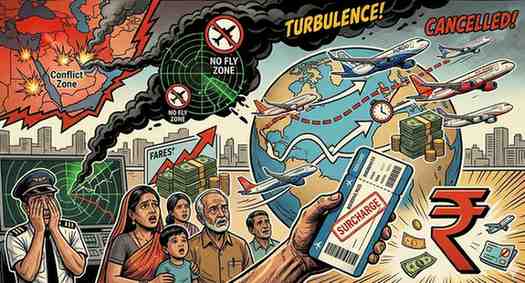
New Delhi, March 2026 — The Indian aviation industry is flying into severe turbulence as the escalating conflict in West Asia cripples flight routes, sending fuel costs and passenger fares skyrocketing.
What started as regional geopolitical tension has now snowballed into a direct financial hit on Indian travelers, compounding an already fragile domestic airline sector reeling from the recent Air India crash and IndiGo’s wave of cancellations.
The Ripple Effect on Fares For passengers, the impact is immediate and unavoidable. Major Indian carriers, including IndiGo, Air India, and Akasa Air, have officially rolled out ticket price hikes ranging from ₹199 to ₹2,300 across various routes and flight categories. The days of affordable quick getaways are rapidly being replaced by sudden fare surges driven entirely by external crises.
Detours, Delays, and Disrupted Routes The core of the issue lies in the skies above West Asia. With the conflict spreading, airlines are forced to take massive, time-consuming detours to bypass hostile airspace.
Longer flights mean higher fuel consumption, which severely drives up daily operational costs. This disruption is particularly damaging for India, as Gulf nations—including the UAE, Qatar, Saudi Arabia, Oman, Kuwait, and Bahrain—accounted for over 50% of the country’s international passenger traffic in 2025. Key hubs like Dubai, Abu Dhabi, Sharjah, Doha, and Jeddah alone represent nearly 40% of India’s international flights, acting as the lifeblood of airline revenue streams.
Global Cancellations and Doubling Fuel Costs The operational nightmare extends well beyond borders:
- Mass Cancellations: Globally, over 50,000 flights have been canceled since the conflict intensified, with Indian carriers accounting for more than 2,000 of those grounded flights.
- Soaring Fuel: Airlines are battling a brutal spike in aviation turbine fuel (ATF) prices. Jet fuel in global markets has nearly doubled, surging from approximately $800 to around $1,600 per ton.
- The Tax Burden: Fuel already eats up 30% to 40% of an airline’s operating budget. During aggressive price shocks like this—amplified by India’s notoriously high state taxes on ATF—fuel expenses can swallow up to 50% of an airline’s total operational costs.
An Industry Already Bleeding This external shock lands precisely when Indian airlines are at their most vulnerable. Recent data presented in Parliament revealed that major carriers—including Air India, Air India Express, Akasa Air, and SpiceJet—posted combined losses of around ₹4,600 crore in the last financial year.
While IndiGo has managed to stay consistently profitable, the airline is wrestling with internal instability following the recent resignation of CEO Peter Elbers, a shakeup that came just months after a crisis forced the carrier to cancel thousands of flights.
Bottom Line The current crisis is a harsh reminder of how exposed India’s aviation market is to global geopolitics. With no immediate end in sight for the West Asian conflict, industry experts warn that travelers must prepare for a grim new normal: longer flight times, fewer route options, and a relentless climb in ticket prices. The era of cheap, seamless international transits may be grounded for the foreseeable future.
Leave a Reply