
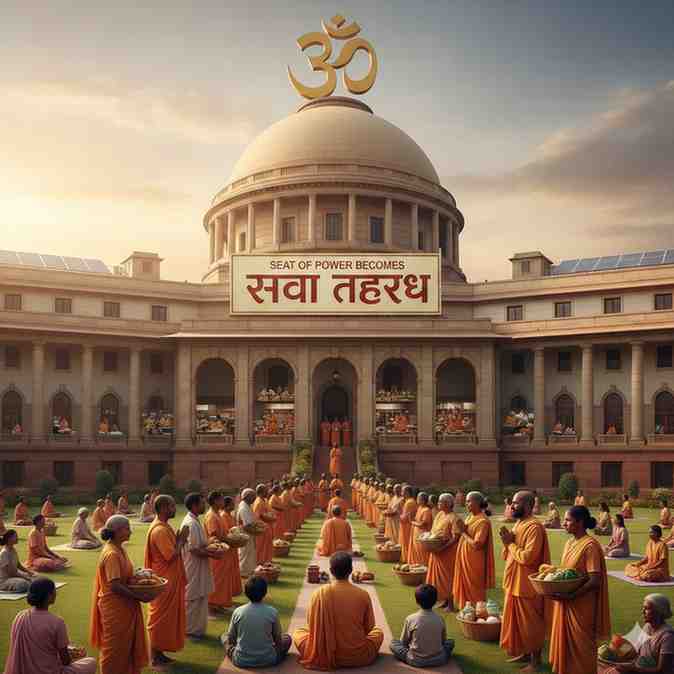
NEW DELHI, February 2026 — In a move laden with historical symbolism, the Union Cabinet has passed a resolution to officially transition the Prime Minister’s Office (PMO) from the colonial-era South Block to a new, modern facility named “Seva Teerth.” The shift, occurring 95 years after the South Block’s inauguration, is being hailed by the government as a definitive break from India’s “shackles of slavery” toward a future defined by indigenous governance and public service.
Shedding the Colonial Shadow
For nearly a century, the North and South Blocks served as the epicenter of power, originally designed by the British to maintain imperial control over India. While the country gained independence in 1947, these structures continued to house the nation’s highest executive offices.
The Cabinet resolution emphasizes that this is not merely a change of address, but a pivot from a “culture of power” (Satta Bhav) to a “culture of service” (Seva Bhav). By moving to “Seva Teerth” (Pilgrimage of Service), the administration seeks to shed the psychological weight of an architectural legacy built for colonial administration.
A Witness to Nine Decades of History
The South Block has been the backdrop for India’s most critical turning points. From the footsteps of Jawaharlal Nehru to the current leadership of Narendra Modi, the building has seen the rise and fall of 16 Prime Ministers.
Within these walls, the nation navigated:
- The Turmoil of the Past: The horrors of partition, multiple wars, and the imposition of the Emergency.
- Modern Reforms: The conceptualization of GST, the Swachh Bharat Abhiyan, and the digital revolution through DBT and Digital India.
- Bold Security Stances: Critical decisions regarding surgical strikes and air strikes that reshaped India’s global security posture.
The Transformation into “Yuge Yugeen Bharat”
Rather than falling into disuse, the North and South Blocks are set for a cultural resurrection. The Cabinet has resolved to integrate these buildings into the “Yuge Yugeen Bharat” National Museum.
This massive project aims to create a museum that spans thousands of years of Indian civilization, turning a former “Seat of Power” into a space that celebrates India’s eternal cultural heritage and inspires future generations.
Bottom Line
The inauguration of Seva Teerth on February 13, 2026, marks the end of an era. By moving the PMO to a technically advanced, environmentally friendly workspace, the government is signaling that the “New India” is ready to operate from a foundation of its own making—leaving the colonial past behind to be studied in a museum rather than lived in the hallways of power.
Leave a Reply