
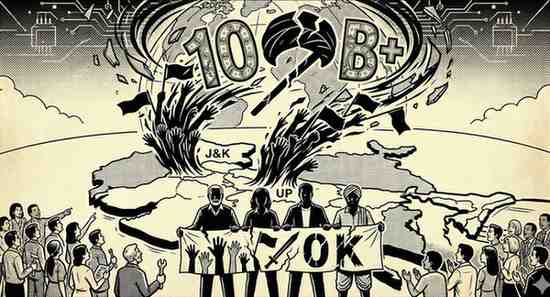
NEW DELHI / SRINAGAR, March 2, 2026 — The assassination of Iran’s Supreme Leader, Ayatollah Ali Khamenei, has triggered a wave of intense emotional and political mobilization across parts of India. While the Middle East grapples with an immediate power vacuum, significant protests have surfaced in Jammu & Kashmir and Uttar Pradesh, highlighting the deep religious and ideological ties between India’s Shia community and the Iranian leadership.
Grief on the Streets: Protests in Srinagar and Lucknow
In the Kashmir Valley, the reaction was swift and visible. Hundreds of people from the Shia community took to the streets of Srinagar, carrying black flags and portraits of Khamenei. The air was filled with anti-U.S. and anti-Israel slogans as protesters engaged in traditional mourning chants.
Similarly, in Lucknow—historically considered a global center for Shia scholarship—community members gathered to display black banners and address assemblies. While the protests in Uttar Pradesh remained largely peaceful, the sentiment was one of profound religious loss. In contrast, South Indian cities like Bengaluru saw a more somber observance, with reports of “mourning silence” in surrounding villages rather than active street protests.
The “Martyrdom” Narrative: Why This Matters to India
The intensity of the response stems from Khamenei’s status not just as a head of state, but as a “Marja” or source of emulation for many Shias worldwide.
- The Population Factor: India is home to an estimated 25 million Shia Muslims, a population rivaling that of Pakistan and surpassed only by Iran itself.
- Symbol of Resistance: For many in J&K and UP, Khamenei was viewed as a guardian of Shia political theology and a primary symbol of resistance against Western dominance.
Diplomatic Contradictions: The “Modi-Netanyahu” Factor
The protests have also brought domestic political grievances to the surface. Many protesters in Lucknow and Srinagar expressed dissatisfaction with India’s growing strategic proximity to Israel. Critics pointed to high-profile meetings between Prime Minister Modi and PM Netanyahu as a point of contention, arguing that India should maintain its distance from the conflict to respect the sentiments of its significant minority population.
A Sectarian Divide?
It is important to note that these protests are not representative of India’s entire Muslim population. The Sunni community, which forms the majority of India’s Muslims, generally does not view the Iranian Supreme Leader as a religious authority. This distinction dates back to the historical division in 632 CE over Islamic leadership, a theological gap that remains visible in today’s varied reactions to Middle Eastern developments.
Bottom Line
The death of Ayatollah Ali Khamenei has proven to be more than a geopolitical event; it is a religious and emotional crisis for millions of Indians. As authorities in Jammu & Kashmir appeal for calm, the events of the past 24 hours underscore how deeply the internal politics of West Asia can resonate within India’s own borders.
Leave a Reply