
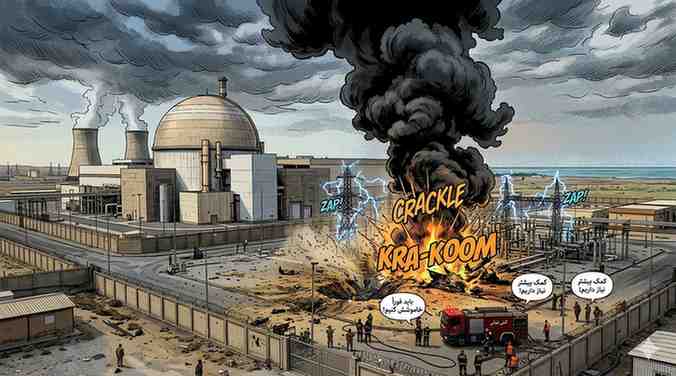
TEHRAN, March 2026 — In a major escalation of the ongoing West Asia conflict, Iran and Russia have confirmed that a projectile struck the grounds of the Bushehr nuclear power plant. While officials from both nations, along with the International Atomic Energy Agency (IAEA), insist there has been no radiation leak or structural damage to the reactor, the incident has triggered a global wave of safety concerns.
The strike occurred near a technical building inside the complex, located on the Persian Gulf coast about 750 kilometers south of Tehran. Despite the lack of immediate “human or financial loss,” the psychological impact is profound, as authorities are reportedly preparing for possible evacuations in the region.
A Strategically Vital Target
The Bushehr plant is Iran’s only operational nuclear power facility. It utilizes a pressurized water reactor to generate 1,000 megawatts of power—enough to supply hundreds of thousands of homes. While it only contributes 1% to 2% of Iran’s total electricity, its geopolitical significance is immense due to its management.
The facility is operated with the assistance of Russia’s nuclear agency, Rosatom, and relies on low-enriched uranium supplied by Moscow. Currently, approximately 480 Russian technicians remain at the site, making any threat to the plant a direct concern for the Kremlin.
Decades of Conflict and Resilience
The story of Bushehr is one of persistent peril. Originally planned in the 1970s with German assistance, the project was halted by the 1979 Islamic Revolution. During the Iran-Iraq War, the site was repeatedly bombed and left in ruins. It wasn’t until 2011, following decades of delays and the eventual support of Russia, that the plant finally became operational.
Today, the site sits at the center of a “perfect storm” following the killing of Iran’s Supreme Leader late last month, which triggered retaliatory attacks across West Asia. In such a high-tension environment, even debris from air-defense interceptions can end up hitting unintended, high-stakes targets like a nuclear facility.
The Borderless Risk of Failure
While the Bushehr plant uses low-enriched uranium, experts warn that any major breach of the reactor would be catastrophic. Unlike conventional targets, a nuclear disaster knows no borders; a significant radiation leak would affect the entire Persian Gulf region and beyond.
As the West Asia war enters this dangerous new phase, the strike on Bushehr serves as a grim reminder that the line between a localized conflict and a regional nuclear catastrophe remains incredibly thin.
Bottom Line
The strike on Bushehr was a “near-miss” that the international community cannot afford to ignore. Though the reactor remains intact for now, the presence of nearly 500 Russian staff and the volatility of the current regional war mean the plant remains a high-tension focal point. For now, a catastrophe has been averted, but the safety of the region hangs by a thread.
Leave a Reply