
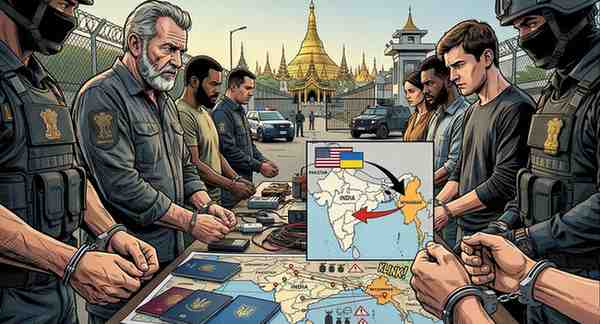
New Delhi, March 2026 — The National Investigation Agency (NIA) has dismantled a high-stakes international conspiracy involving a U.S. citizen and six Ukrainian nationals, allegedly operating a terror-linked training hub on the India-Myanmar border.
What federal investigators are calling a “grave threat to national sovereignty,” defense analysts describe as a rare and dangerous intersection of Western private military expertise and South Asian insurgency.
The Shadows of “Sons of Liberty”
At the center of the storm is Matthew Van Dyke, a high-profile American security analyst and founder of the non-profit Sons of Liberty International. Known for his role as a foreign fighter in the Libyan Civil War, Van Dyke’s transition from a documentary filmmaker to an alleged trainer for anti-India insurgents has shocked the international community.
The NIA alleges that Van Dyke and six Ukrainians utilized India as a transit point, entering on tourist visas before illegally infiltrating the protected forests of Mizoram to reach Myanmar.
Drones, Jammers, and Dark Networks
This wasn’t a grassroots rebellion; it was a high-tech paramilitary operation. According to NIA filings, the group provided specialized training to ethnic armed groups in:
- Drone Warfare: Teaching insurgents how to assemble and pilot offensive drones.
- Signal Jamming: Deploying technology to disrupt military communications.
- Smuggling: Coordinating a “huge consignment” of drones shipped from Europe through Indian territory.
The agency informed the court that the suspects confessed to these activities during interrogation, admitting they were actively “abetting terrorists wielding AK-47s” who pose a direct threat to India’s Northeastern states.
A Geopolitical Chess Match
The arrests have triggered an immediate diplomatic “cold war.”
- The Russian Connection: Reports suggest the arrests were made possible by a Russian intelligence tip-off, highlighting a rare moment of security alignment between Moscow and New Delhi to intercept Western “mercenaries.”
- Ukraine’s Protest: Kyiv has issued a formal note of protest, demanding the immediate release of its citizens. Ukrainian officials argue that the suspects may have “unintentionally” violated border rules due to a lack of proper signage in restricted areas.
- Washington’s Silence: The U.S. Embassy has remained tight-lipped, citing privacy reasons, even as U.S. Ambassador Eric Garcetti held urgent high-level talks with India’s National Security Advisor, Ajit Doval.
The Verdict on Border Security
The court has placed the seven foreigners in NIA custody until March 27th, invoking Section 18 of the UAPA (Unlawful Activities Prevention Act).
The case exposes a chilling reality: India’s borders are no longer just facing local militants, but are becoming a playground for international “guns for hire” and sophisticated tech-warfare experts. For the NIA, the message is clear—India’s security is not for sale, and the “tourist” mask has officially been stripped away.
Bottom Line The era of foreign “volunteers” operating under the radar in India’s sensitive border zones is over. Whether these men were idealists or mercenaries, their presence has forced a massive recalibration of India’s counter-terrorism strategy in the East.
Leave a Reply