
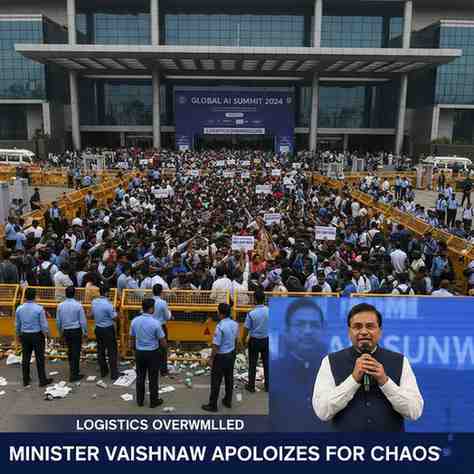
New Delhi, February 2026 — Union Minister Ashwini Vaishnaw has issued an official apology to tech professionals and young attendees following a chaotic opening day at India’s flagship Artificial Intelligence (AI) summit. While the event was hailed as a landmark for Indian innovation, the sheer volume of visitors—estimated at 70,000—exposed major logistical gaps that left many frustrated.
A “phenomenal” Turnout Meets Operational Mess
The summit, billed as the world’s largest AI gathering, saw an energy the Minister described as “palpable.” However, that energy quickly turned into a management nightmare as the venue struggled to accommodate the massive influx of people. Techies and students took to social media to flag long queues, entrance confusion, and general mismanagement.
Responding to the criticism, Vaishnaw stated, “If anybody has faced any problems yesterday, my apologies for that”. He confirmed that a 24-hour “war room” has been established to tackle feedback and streamline operations for the remaining days of the summit.
Sovereign AI: Beating Global Giants
Despite the logistical hurdles, the summit marked a significant milestone for Indian software. The government launched a “sovereign bouquet” of AI models that have been benchmarked against the world’s most famous large language models.
The Minister proudly noted that on several key parameters, these homegrown Indian models have actually been rated higher than established global competitors. This achievement is seen as a testament to India’s innovation capabilities, with Stanford recently ranking India among the top three AI nations globally.
The GPU Arms Race and AI Mission 2.0
To maintain this momentum, the government announced the transition to AI Mission 2.0. While the first phase focused on building common compute infrastructure, the second phase will shift focus heavily toward Research and Development (R&D) and “AI diffusion”—ensuring AI tools reach every sector of the economy.
To power this mission, India is rapidly scaling its hardware. The Minister announced that the government will place orders for an additional 20,000 GPUs within the next week. These will be deployed over the next six months, adding to the 38,000 GPUs already in place to support startups, students, and researchers.
The Global Consensus on AI Safety
Addressing the darker side of technology, Vaishnaw highlighted a growing global consensus on the need to contain the harmful impacts of AI. Rather than relying solely on rigid legislation, India is advocating for a “techno-legal approach”.
Through a virtual AI Safety Institute, the government is collaborating with academic institutions to build technical solutions that can identify and block harmful content at the source. The goal is to ensure technology remains “democratized,” preventing AI infrastructure from being controlled by only a handful of global corporations.
Bottom Line
The Day 1 “mess” was a sobering reminder that India’s physical infrastructure must keep pace with its digital ambitions. However, with an apology on the record and a massive GPU expansion underway, the government is betting that India’s sovereign AI will eventually outshine the logistical stumbles.
Leave a Reply