
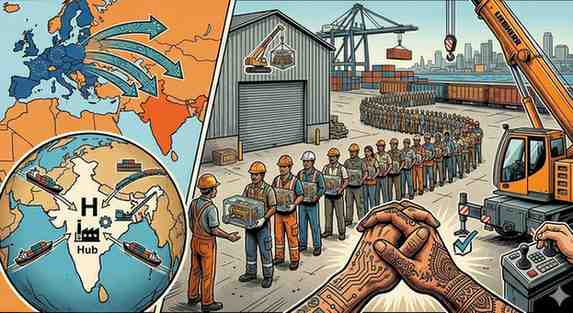
New Delhi, March 2026 — In a stark reflection of how geopolitical tensions are rewriting global supply chains, multinational equipment giant Liebherr plans to bypass European sanctions on Russia by leveraging its manufacturing base in India. What initially looked like a crippling blow to European exports is rapidly turning into a massive strategic opportunity for South Asian manufacturing.
A Sanction-Proof Supply Chain For multinational corporations, operating in a heavily sanctioned, protectionist environment has become a logistical nightmare. Historically, Russia was a massive market for Liebherr’s European factories. However, the ongoing geopolitical conflict and subsequent tariffs have effectively slammed that door shut, bringing direct European exports to a complete halt. But behind the scenes, a strategic pivot is underway. Liebherr India’s Kapil Agarwal confirmed that while European units remain blocked, the company intends to supply the Russian market directly from its Indian factories, stating that these changing situations “offer opportunities.”
India: The New Manufacturing Mediator This pivot relies on a massive upgrade in local capabilities. Previously, Liebherr did not manufacture products in India capable of catering to the heavy demands of the Russian market. Now, with the commencement of fully integrated local production, the vacuum left by European sanctions is being filled. This mirrors a broader macroeconomic trend over the past few years: India successfully acting as a vital mediator and processing hub. Just as India stepped up to process Russian oil and gas for the global market, it is now stepping up to manufacture heavy equipment for a sanctioned Russia.
The Catalyst: The India-EU Trade Deal Beyond serving as a geographical workaround, Liebherr is banking heavily on the newly cemented India-EU trade deal. For the heavy equipment and appliance industry, the agreement is a game-changer. The primary hurdle for European manufacturers in India has historically been steep import duties on components and the complex transfer of technology. Under the new pact, these crippling tariffs will be slashed. This allows for the frictionless, duty-free transfer of essential European technological know-how and parts directly to Indian assembly lines.
Trickle-Down Benefits for the Consumer The elimination of these tariffs is not just a corporate victory; it translates directly into savings for the Indian consumer. Agarwal noted that components imported for everyday consumer products, such as refrigerators, will no longer attract heavy taxes. As the cost of acquiring these parts drops to zero duty, the overall manufacturing expenses for locally assembled units will plummet. These massive corporate savings are slated to be passed down the chain, resulting in noticeably lower retail prices for end-users.
Bottom Line The era of rigid, single-origin supply chains is over. Liebherr’s strategic maneuver highlights a new reality in global trade: sanctions on Europe no longer mean a closed market. By capitalizing on India’s neutral geopolitical stance and the lucrative India-EU trade pact, multinationals are not only keeping their global sales pipelines alive but are actively transforming India into a powerhouse export hub—bringing cheaper goods to locals while supplying the sanctioned world.
Leave a Reply