
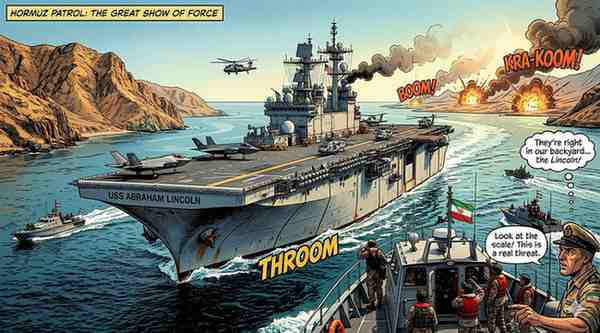
NORTH ARABIAN SEA, March 23, 2026 — In a major expansion of the U.S. military presence in West Asia, the USS Tripoli, a 50,000-ton amphibious assault ship, is currently steaming toward the North Arabian Sea. Currently positioned south of Sri Lanka, the vessel is expected to enter the active conflict zone near the Strait of Hormuz by tonight or early tomorrow morning.
A Floating Fortress on the Horizon
The USS Tripoli is not merely a transport ship; it is a high-tech mobile military base. It serves as a launchpad for some of the world’s most advanced aerial assets, including the F-35 Lightning II stealth fighter and the V-22 Osprey tiltrotor aircraft.
Carrying more than 2,000 Marines from the 31st Marine Expeditionary Unit, the Tripoli brings a “ground-force” dimension to a theater that has so far been defined by air and missile strikes. Its arrival is intended to reinforce the USS Abraham Lincoln carrier strike group, creating a massive naval concentration designed to break the current regional deadlock.
The 33km Chokehold
The strategic core of this mission is the Strait of Hormuz, a narrow passage just 33 km wide at its tightest point. This waterway is the world’s most critical energy artery; however, it is currently under severe threat.
Iran has utilized drones, missiles, and fast-attack boats to create a functional chokehold on global energy supplies. This blockade has pushed global crude prices to their highest levels since 2022, with Brent crude hovering near $110 a barrel. The Tripoli’s primary directive could involve “freedom of navigation” operations—escorting oil tankers to ensure the global economy does not grind to a halt.
Marines on the Ground: The Trump Strategy
While U.S. President Donald Trump has officially stated that “no troops are being deployed” into Iran for the time being, the Tripoli’s specific capabilities tell a different story.
Unlike a traditional carrier, this ship is equipped with landing craft designed to deploy Marines directly onto hostile shores. Military analysts suggest that if the Strait remains blocked, the Marines could be used in “aggressive options” to seize and secure strategic Iranian coastal infrastructure, ensuring shipping routes are cleared by force if necessary.
Succession and Retaliation
This naval maneuver comes in the wake of the joint U.S.-Israeli strike that killed Iran’s Supreme Leader Ali Khamenei, triggering a wave of retaliatory drone and missile attacks across the region. The Tripoli is arriving at a moment when the Iranian leadership is in flux and the risk of miscalculation at sea has never been higher.
Bottom Line
The deployment of the USS Tripoli signals that the U.S. is moving beyond “containment” and into “enforcement.” By placing 2,000 Marines at the mouth of the Strait of Hormuz, the masks are off: the U.S. is signaling that it is prepared to reclaim the world’s most vital shipping lane, whether through deterrence or direct coastal intervention.
Leave a Reply