
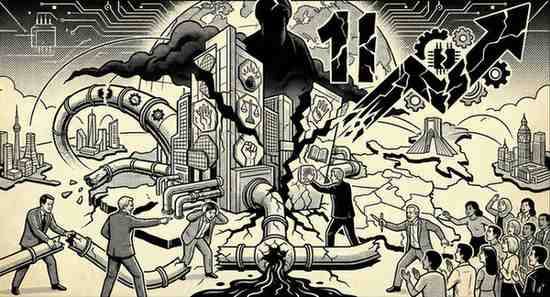
TEHRAN, March 1, 2026 — The Middle East has entered its most volatile chapter in nearly fifty years. Following a massive coordinated airstrike by U.S. and Israeli forces, Iran’s Supreme Leader, Ayatollah Ali Khamenei, has been confirmed dead. The strike, which targeted the high-security leadership compound in Tehran, did not just eliminate a figurehead; it effectively decapitated the religious and military hierarchy that has governed the Islamic Republic for decades.
Decapitation Strike: The Khamenei Compound Leveled
The operation involved over 30 heavy munitions specifically designed to penetrate fortified structures. Surveillance imagery confirmed that the Supreme Leader’s compound, the nerve center of Iranian policy for 37 years, was entirely destroyed.
The casualties extend far beyond Khamenei himself. The strike wiped out a significant portion of the inner circle, including Mohammad Pakpour, the high-ranking Commander of the Islamic Revolutionary Guard Corps (IRGC), and Defense Minister Amir Nasirzadeh. Reports from the ground indicate that several of Khamenei’s immediate family members were also present during the attack and did not survive.
The Power Vacuum: A Constitutional Crisis
For the first time in nearly four decades, Iran faces an absolute power vacuum. Under Article 111 of the Iranian Constitution, a temporary council has been formed to prevent a total state collapse. This council currently includes:
- President Masoud Pezeshkian
- The Chief of the Judiciary
- A representative from the Guardian Council
While this trio holds the reins for now, the ultimate successor must be chosen by the Assembly of Experts, an 88-member panel of senior clerics. However, with the military leadership in shambles and the Guardian Council—which vets all candidates—weakened by the strikes, the path to a new “Supreme Leader” is anything but clear.
Internal Dissent: The Call for a “New Iran”
The death of Khamenei has reignited long-smoldering domestic tensions. Opponents of the regime, ranging from the National Council of Resistance of Iran to the descendants of the former Pahlavi dynasty, are calling for the total dismantling of the Islamic Republic.
U.S. and Israeli leaders have echoed these calls, urging the Iranian people to “seize control of their destiny” while the security apparatus is in disarray. This marks a shift from foreign policy aimed at containment to one openly advocating for a transition to secular democracy.
The IRGC’s Last Stand and Regional Fallout
Despite the loss of its top commanders, the remaining elements of the IRGC have sworn a “blood oath” of retaliation. A temporary chief, Brigadier General Ahmad Vahidi, has been appointed to coordinate a response.
Already, retaliatory strikes have been reported in Dubai and across the Persian Gulf, targeting commercial hubs and infrastructure as the regime’s proxies attempt to prove they are still functional. These actions have turned once-safe international cities into active conflict zones, further isolating Iran from its neighbors.
Bottom Line
The era of Ayatollah Ali Khamenei was defined by absolute religious authority and regional proxy warfare. With his death, the central pillar of the Islamic Republic has collapsed. Iran now stands at a crossroads: it will either descend into a protracted civil war led by a fractured military or undergo a radical transformation that could end 47 years of clerical rule.
Leave a Reply