
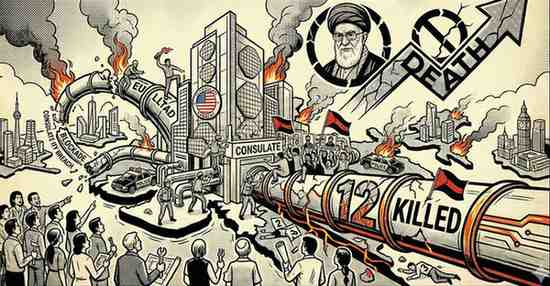
KARACHI / NEW DELHI, March 1, 2026 — A violent confrontation at the United States Consulate in Karachi has left at least 12 people dead after an angry mob attempted to storm the diplomatic compound. The unrest was sparked by the news of the assassination of Iran’s Supreme Leader, Ayatollah Ali Khamenei, which has triggered pro-Iran and anti-Western demonstrations across several Muslim-majority regions.
The Siege: Security Breach at the Consulate
The situation escalated rapidly as hundreds of protesters, primarily from the Shia community, marched toward the US Consulate located near the Mai Kolachi Bypass in Karachi. Despite multiple layers of barricading by the Karachi police and paramilitary forces, the crowd, chanting anti-US and anti-Israel slogans, managed to breach the outer security perimeter.
Witnesses reported that protesters used force to break through the outer walls and began acts of arson and vandalism within the consulate’s inner layer. This direct threat to diplomatic personnel and sensitive information triggered an immediate response from the US Marine Security Guards stationed inside the facility.
A Lethal Response: US Marines Open Fire
Under international diplomatic protocols, a consulate is considered sovereign territory of the represented nation, and security guards are authorized to use lethal force if “red lines” are crossed. After reportedly issuing multiple warnings and deploying tear gas, the US Marine guards opened fire on the advancing mob to prevent a total takeover of the building.
While initial reports suggested a lower death toll, local officials have confirmed that at least 12 protesters have been killed in the firing. The US Embassy in Pakistan has since issued an emergency travel advisory, urging all US citizens to avoid crowded areas and monitor local news as the threat of retaliatory attacks remains high.
The Shia Factor: A Regional Ripple Effect
The violence in Karachi is part of a broader “geopolitical shock” felt across the region. Pakistan is home to the world’s second-largest Shia population, approximately 35 to 40 million people, many of whom look to the Iranian Supreme Leader for religious and theological guidance. Similar, though less violent, protests have been reported in Lahore, Islamabad, and as far away as Baghdad, Iraq.
Bottom Line
The tragic loss of life in Karachi underscores the dangerous intersection of religious grief and anti-Western fervor. The “masks are off” regarding the volatile nature of proxy sentiments in the region. As international laws regarding diplomatic protection are stretched to their limits, the world watches to see if this “bubble” of unrest will expand further across the Middle East and South Asia.
Leave a Reply