
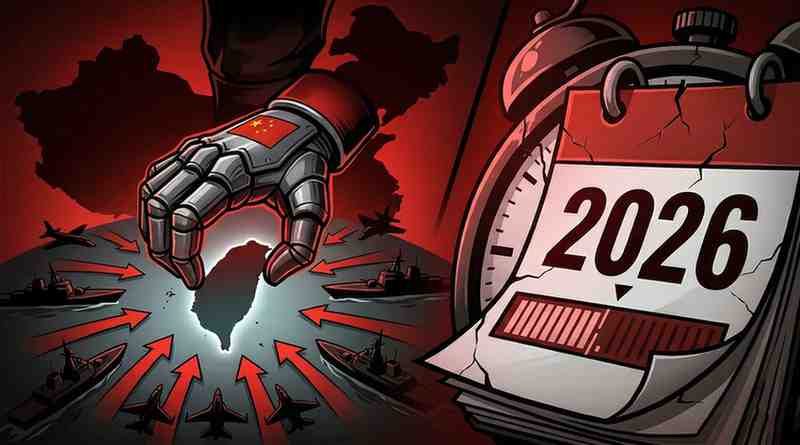
Beijing, March 2026 — The clock is ticking on what President Xi Jinping calls the “historic mission” of Chinese reunification. As the People’s Liberation Army (PLA) nears its 2027 modernization deadline, 2026 has emerged as the critical “year of temptation” for a move against Taiwan.
What Beijing describes as the “Great Rejuvenation” of China, global analysts view as a calculated plan to dismantle Taiwan’s sovereignty through a blend of psychological warfare and strategic exhaustion.
The 2026 Window: Why Now?
While 2027 is the official centenary of the PLA, 2026 provides a perfect storm of opportunity. Internal reports suggest Xi Jinping views this year as a final window for preemptive action due to a “dangerous overlap” of global factors:
- Military Readiness: The PLA has been ordered to be “combat-ready” for a Taiwan takeover by early 2027, making 2026 the year for final positioning.
- The “Trump Factor”: Beijing is closely watching the unpredictability of U.S. foreign policy. Analysts suggest that if the U.S. becomes distracted by internal shifts or other territorial interests, China may strike while the “global shield” around Taiwan is weakened.
The “Anaconda Strategy”: Death by a Thousand Coils
Beijing is moving away from the idea of a sudden, bloody “D-Day” style invasion. Instead, they have deployed the “Anaconda Strategy”—a slow, suffocating squeeze designed to win without a full-scale war.
- Grey Zone Tactics: Every week, Chinese jets violate Taiwan’s air defense zones, and naval ships circle the island. These aren’t just drills; they are designed to exhaust Taiwan’s pilots and sailors.
- Psychological Siege: By simulating blockades and launching missiles over the island, Beijing aims to collapse Taiwanese morale and force a “peaceful” surrender before a single troop lands on a beach.
The High Stakes of Silicon and Security
This isn’t just about territory; it’s about the engine of the modern world. Taiwan produces over 90% of the world’s most advanced semiconductors.
- Economic Leverage: If Beijing controls Taiwan, it controls the “brains” of every iPhone, AI server, and fighter jet on the planet.
- Maritime Dominance: Capturing Taiwan breaks the “First Island Chain,” giving China’s navy unrestricted access to the Deep Pacific and directly threatening the security of Japan and the Philippines.
Legacy vs. Ruin: Xi’s Final Gamble
For Xi Jinping, Taiwan is the ultimate prize for his legacy. Capturing the island would cement him as a “Super Leader” on par with Mao Zedong. However, the risks are catastrophic. A failed invasion or a prolonged maritime war could lead to:
- Economic Collapse: Massive global sanctions that would make the measures against Russia look “minor.”
- Internal Unrest: Heavy military casualties could weaken the Communist Party’s grip on power at home.
Bottom Line
The era of “strategic ambiguity” is fading. Beijing’s message is clear: reunification is non-negotiable and “force remains on the table.” As 2026 approaches, the world is watching to see if the Anaconda will finally tighten its grip, or if the cost of the squeeze remains too high for the dragon to bear.
Leave a Reply