
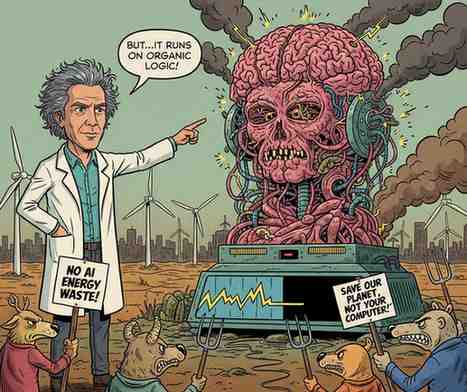
OpenAI CEO Sam Altman has ignited a global firestorm of criticism following a controversial defense of the massive energy consumption required to develop and operate Artificial Intelligence. Speaking at the Express Auto event, Altman drew a direct comparison between the electricity used to train AI and the biological energy consumed by humans, a parallel that critics are calling “dehumanizing” and “cold”.
The remarks come at a time when the environmental footprint of data centers is under intense scrutiny, as AI models grow increasingly complex and power-hungry.
The Comparison: AI vs. 20 Years of Human Food
Altman argued that the public discourse surrounding AI’s energy cost is “unfair” because it ignores the inherent “training cost” of human intelligence. He posited that for a human to become smart enough to perform tasks similar to an AI, it requires 20 years of life and the total consumption of all food eaten during that period.
“The fair comparison,” Altman stated, “is you ask ChatGPT a question—how much energy does it take that model to answer versus a human?” He suggested that on an energy-efficiency basis, AI has likely already caught up to human capabilities. He further dismissed viral internet claims regarding water usage—such as a single query consuming 17 gallons of water—calling them “nowhere near” the actual amounts.
Industry Backlash: “A Dehumanizing Worldview”
The response from the tech community was swift and sharp. Zoho co-founder Sridhar Vembu was among the most vocal critics, stating that technology should “quietly recede into the background” rather than dominate or be equated to human life.
Other critics, including author David Fairchild, slammed the remarks as a “dehumanizing worldview,” arguing that humans are not merely “inefficient meat computers” whose value is defined by computational utility. Critics noted that true intelligence is born from emotional landscapes, societal bonds, and existential struggles—qualities no algorithm can replicate.
Efficiency vs. Existential Value
While some defenders argued that Altman was strictly discussing thermodynamics and trying to dismantle the energy-use argument rather than commenting on the value of life, the consensus remains skeptical. The controversy highlights a growing rift in the tech sector: should AI be integrated as a dominant force that competes with human effort, or as a background utility that simplifies life?
Bottom Line
Altman’s attempt to normalize AI’s carbon footprint by comparing it to the human diet has backfired, exposing deep-seated anxieties about the philosophical role of AI. As the scrutiny over energy consumption continues, the tech industry faces a defining question: Is AI a tool for humanity, or is humanity simply the baseline for AI’s efficiency?
Leave a Reply