
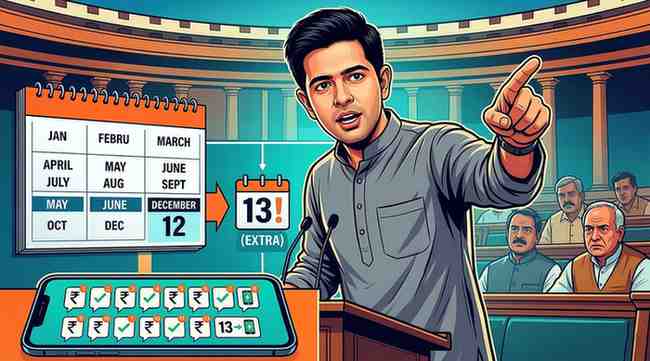
New Delhi, March 11, 2026 — Aam Aadmi Party (AAP) MP Raghav Chadha has ignited a fierce debate in the Rajya Sabha, accusing telecom operators of exploiting over 112 crore prepaid mobile users. Terming the current billing practices as “arbitrary and predatory,” Chadha has called for immediate regulatory intervention to protect the digital rights of Indian citizens.
What Chadha describes as a “mathematical manipulation” of the calendar, telecom companies maintain is a standard global billing practice.
The 28-Day Trap: Engineering a 13th Month
The core of Chadha’s argument rests on the industry-standard 28-day recharge cycle. While consumers perceive these as “monthly” plans, the two-day shortfall every month adds up to a full extra month over the course of a year.
By calculating 28 days multiplied by 13 recharges, the total comes to 364 days. This “clever strategy” forces users to pay for 13 months of service within a 12-month calendar year. Chadha pointed out that while salaries, rents, and utility bills follow the 30-day cycle, telecom operators have detached themselves from the calendar to maximize revenue at the consumer’s expense.
Silencing the Digital Identity
Beyond billing, Chadha highlighted the “harsh” practice of suspending incoming services immediately upon the expiry of a prepaid plan. In a modern, digital India, a mobile number is no longer just a luxury; it is a vital digital identity linked to Aadhar, UPI, and banking.
When incoming calls and SMS are blocked:
- Essential Alerts: Users miss critical OTPs for banking, train tickets, and government services.
- Social Connectivity: Low-income users, particularly those in rural areas, are cut off from emergency calls from family or job opportunities.
“Your Aadhar doesn’t expire just because you haven’t updated it, and your bank account isn’t closed if you miss a deposit,” Chadha argued, characterizing the suspension of incoming services as a violation of the “Right to Communication”.
The Three-Point Demand for Reform
To curb what he termed as “corporate high-handedness,” Chadha proposed three specific reforms to the House:
- Guaranteed Incoming: Ensuring incoming calls and SMS remain active for at least one year from the date of the last recharge.
- Extended Grace Period: A three-year protection period before a deactivated number is re-allotted to a new user.
- Low-Cost Vitality Plans: Forcing operators to introduce ultra-low-cost plans (e.g., ₹10 for 180 days) specifically for those who only require incoming connectivity.
Bottom Line
The era of the “28-day month” has come under intense parliamentary scrutiny. Chadha’s intervention suggests that the “illusion of affordability” in India’s telecom sector is being fueled by a hidden 13th-month tax on the poor. As the digital divide narrows, the government is now being pressured to ensure that a missed recharge doesn’t mean a total digital blackout for the common man.
Leave a Reply