
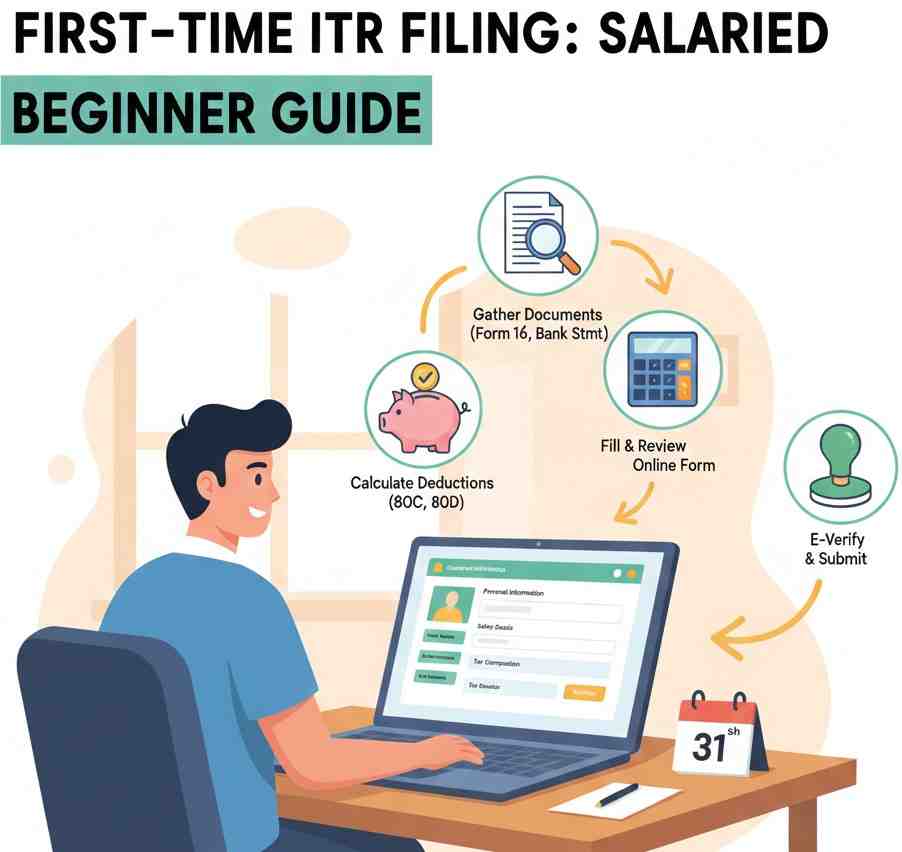
Key highlights
- Most first-time salaried filers use ITR-1 (Sahaj) if they’re a resident with income up to ₹50 lakh from salary/pension + one house property + interest/other sources (with a few important exceptions). Income Tax Department
- Don’t file “blind.” Match your salary TDS, bank interest, and other reported entries with AIS/TIS (because Form 26AS is now largely TDS/TCS-focused, while AIS carries broader info). Income Tax Department
- Filing is incomplete until you e-verify (generally within 30 days of filing). Income Tax Department
Step 1: First, pick the right ITR form (this avoids 80% of beginner mistakes)
Most salaried individuals fit ITR-1 when:
- Resident (not RNOR), total income up to ₹50 lakh
- Income from salary/pension, one house property, and other sources like interest/dividend, etc. Income Tax Department
You cannot use ITR-1 if you are, for example, a company director, hold unlisted shares, have foreign assets/income, certain capital gains situations, or total income exceeds ₹50 lakh. Income Tax Department
Quick self-check question:
“I have salary + bank interest only. No foreign stuff. No business income. No complex gains.” → You’re usually in ITR-1 territory. Income Tax Department
Step 2: Gather your “filing pack” (so you don’t keep switching tabs mid-way)
For a salaried beginner, keep these ready:
- Form 16 from employer (your salary + TDS certificate) Income Tax Department
- Interest certificates / bank interest summary (savings + FD interest)
- Proofs for deductions you’re claiming (80C, 80D, etc.)
New-ish detail that surprises first-timers:
From AY 2025–26, the portal expects additional information for several deductions (example: 80C may need policy/document identifiers; 80D may need insurer/policy details, etc.). Income Tax Department
Step 3: Check AIS/TIS before you submit (this is your “reality mirror”)
AIS is where the system may show:
- Interest reported by banks
- High-value transactions (where applicable)
- Other reported entries beyond basic TDS/TCS
Also note: from AY 2023–24 onwards, Form 26AS on TRACES shows mainly TDS/TCS, while other details are available in AIS. Income Tax Department
Small question people search: “What if AIS shows wrong info?”
AIS allows you to view and submit feedback on reported transactions through the portal flow. Income Tax Department
Step 4: File on the portal (simple flow, but don’t rush the tax regime choice)
On the Income Tax e-filing portal, you typically:
- Start a new return → choose Assessment Year correctly
- Select the right ITR form (often ITR-1 for salaried) Income Tax Department
- Use pre-filled data, then edit/validate with Form 16 + AIS
- Fill deductions carefully (and add the extra deduction details when prompted). Income Tax Department
Scenario (very common):
You joined your first job in June and changed jobs in November. You’ll likely have two Form 16s (or one Form 16 + interim statement). If you only enter one employer’s numbers, your tax credit can mismatch, and refunds get delayed. Your fix is simple: combine salary + TDS accurately and cross-check with AIS/TDS schedules.
Step 5: E-verify (without this, it’s basically “not finished”)
The department’s stated rule: e-verification / ITR-V submission time limit is 30 days from the date of filing. Income Tax Department
Small question people search: “What if I filed but forgot to verify?”
Your return can remain unverified; the portal provides processes (including condonation workflows in some cases), but the clean approach is: verify within time, every time. Income Tax Department
Step 6: Missed the deadline? Don’t panic—know the buckets
- If you file after the due date, the portal FAQ warns you may face late filing fee/interest. Income Tax Department
- The portal also indicates 139(4)/139(5) time limits are “31st December of respective AY as of now” (useful for belated/revised planning). Income Tax Department
Final “beginner-safe” checklist
- Correct ITR form (ITR-1 vs ITR-2/3/4) Income Tax Department
- Form 16 + AIS/TIS cross-check Income Tax Department
- Deductions entered with required extra details (AY 2025–26 onwards) Income Tax Department
- E-verified within 30 days
Leave a Reply