
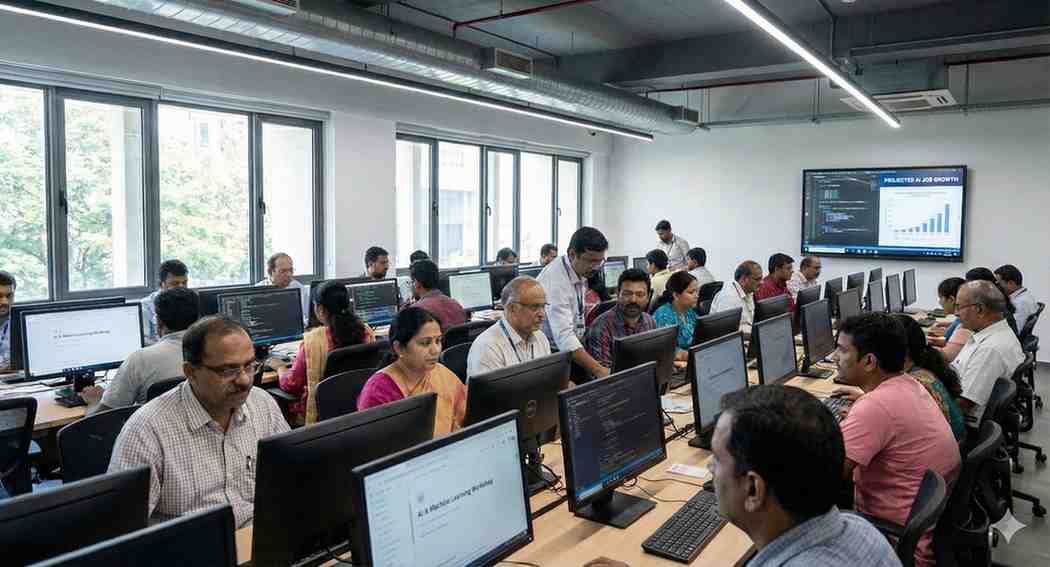
With substantial investments and a multi-pronged strategy, the government aims to prepare India’s workforce for the AI-driven economy.
Key Highlights
- ₹8,500 crore allocated to AI and digital skill development under the Digital India program.
- Over 1.8 million learners enrolled under the FutureSkills PRIME initiative.
- Establishment of 300 AI skill hubs planned across rural and urban regions.
- National AI Portal (INDIAai) operational as a central repository for AI resources and education.
- YUVAi program introduces AI training for school students from grades 8 to 12.
The Government of India is making a decisive move to upskill the workforce as part of its Digital India initiative, ensuring readiness for the rapid advancements in Artificial Intelligence (AI) and related technologies. With an investment of ₹8,500 crore, these initiatives aim to bridge the skill gap and empower millions with competencies in AI, machine learning, and data analytics.
The FutureSkills PRIME initiative, developed by the Ministry of Electronics and Information Technology (MeitY) in collaboration with NASSCOM, has already enrolled over 1.8 million learners. The program focuses on emerging technologies, including AI, cloud computing, and cybersecurity, and offers industry-recognized certifications.
In addition, the National AI Portal (INDIAai), launched in 2020, serves as a comprehensive resource for articles, news, and tools related to AI development. It supports professionals, students, and researchers in gaining access to the latest advancements and opportunities in the AI domain.
Major Components of the Initiative
- Skill Hubs: Plans are underway to establish 300 AI skill hubs across rural and urban regions, enabling accessibility for underserved communities.
- Youth-Oriented Programs: The YUVAi initiative introduces AI training for school students from grades 8 to 12, fostering early exposure to technology.
- Data Labs: AI Data Labs are operational in cities like Lucknow, Shimla, and Patna to promote innovation and local AI applications.
Official Projections
The World Economic Forum estimates that 97 million new roles will be created globally by 2025 due to advancements in AI and automation. India’s strategy aims to capture a significant share of this opportunity by equipping its workforce with cutting-edge skills.
Challenges and Road Ahead
While the initiative holds immense promise, experts highlight the challenges of ensuring quality training and equitable access in rural areas. Sustained collaboration with private sector stakeholders is seen as critical to the program’s scalability and success.
Conclusion
India’s ambitious plans to upskill its workforce for the AI revolution reflect a forward-thinking approach to economic resilience and technological leadership. By focusing on inclusivity and robust execution, these efforts could position the nation as a global leader in AI innovation.
Leave a Reply