
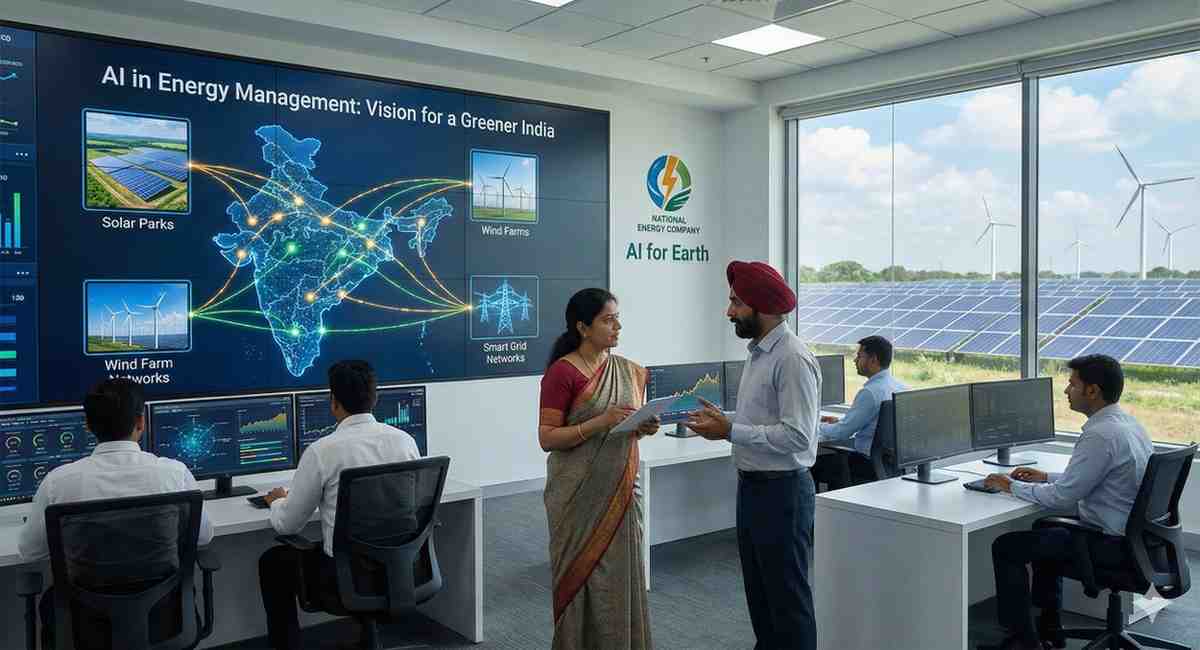
With artificial intelligence as the torchbearer, India takes bold steps toward an energy-efficient and sustainable future.
Key Highlights
- National Smart Grid Mission enabling real-time energy management since 2015.
- ₹990 crore dedicated to AI Centres of Excellence to drive innovation in energy technologies.
- The IndiaAI Mission, with a ₹10,371.92 crore budget, aims to transform energy management among other critical sectors.
- Aiming for 500 GW renewable energy capacity from non-fossil fuel sources by 2030.
In the quest for a sustainable future, India is turning to Artificial Intelligence (AI) to revolutionize how the nation consumes and conserves energy. The government’s initiatives are not just about technology but about reshaping lives, securing resources, and preparing for a future where efficiency and sustainability define progress.
At the heart of this transformation is the National Smart Grid Mission (NSGM), introduced in 2015, which is modernizing power grids to make them smarter, more efficient, and capable of real-time energy management. This isn’t just an upgrade in technology—it’s about ensuring that every watt of electricity reaches its destination without waste, serving millions more households and businesses with the same resources.
But innovation needs more than just ambition—it requires the right platforms. This is why the government has allocated ₹990 crore to establish AI Centres of Excellence, dedicated to creating advanced solutions for energy efficiency. These centers are setting the stage for breakthroughs that can predict energy demand, reduce wastage, and optimize renewable resource usage.
The IndiaAI Mission, a landmark program funded with ₹10,371.92 crore, further bolsters these efforts. It symbolizes the government’s belief that AI isn’t just a tool—it’s a partner in shaping the future. By integrating AI into energy systems, the mission promises solutions that address the country’s unique challenges, from managing peak electricity loads in urban areas to ensuring sustainable power for remote villages.
Renewable energy, too, stands at the core of India’s strategy. With a target of achieving 500 GW of renewable energy capacity by 2030, AI plays a critical role in ensuring that solar panels absorb the right amount of sunlight, wind turbines spin at optimum speeds, and hydropower plants operate efficiently.
But what does this mean for the average Indian? It means uninterrupted power in their homes, reduced electricity bills, and the knowledge that the energy they consume is sustainable. It’s the promise of a future where no child studies by candlelight, where businesses don’t halt for power cuts, and where growth doesn’t come at the cost of the environment.
Challenges and Opportunities
Despite the promise, challenges remain. Building robust infrastructure, training professionals, and ensuring equitable access to these technologies are hurdles that must be overcome. Collaboration with the private sector and community-driven programs will be essential to bridge these gaps.
Conclusion
India’s journey into AI-driven energy management isn’t just about technology—it’s about people, progress, and preserving the planet. With each step, the government is not only addressing today’s energy needs but also laying the groundwork for generations to come. As the nation moves toward a cleaner, smarter energy ecosystem, it sets a powerful example of how innovation can serve humanity at its core.
Leave a Reply