
Key Highlights
- Winter 2026 is expected to be defined by sharper ‘ventilation swings’—days of wind-driven relief followed by rapid re-accumulation under calm conditions.
- CAQM’s winter measures increasingly target local sources (waste burning, dust, vehicles) alongside episodic actions under GRAP.
- CPCB’s winter action framework keeps daily monitoring and forecasting at the center, reflecting a more operational, data-driven approach.
- Stubble-burning contribution can be low on many days, yet Delhi can still see ‘very poor’ air due to local emissions plus inversion.
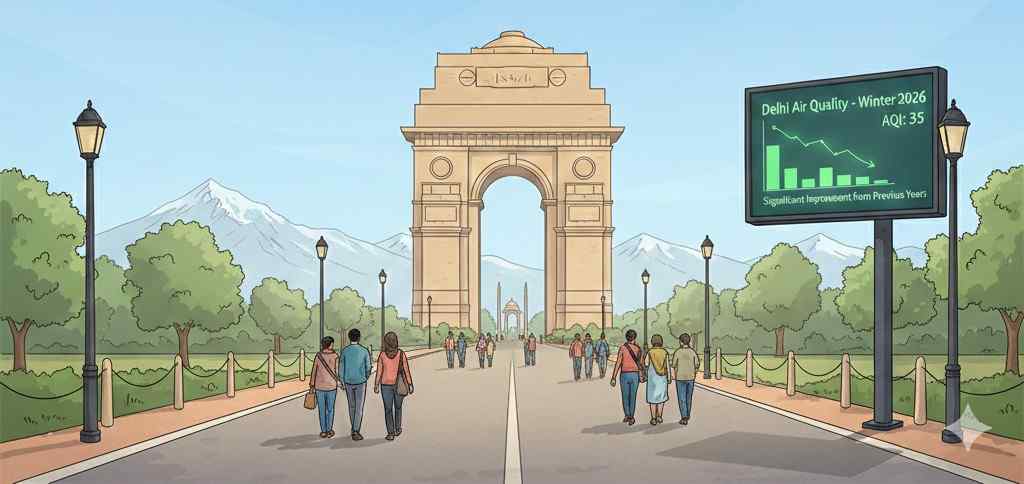
Delhi’s winter air has always been harsh, but the pattern is evolving. The winter of 2026 (Dec 2025–Feb 2026) is shaping up to be less about one continuous “smog season” and more about repeated cycles: accumulation, collapse, rebound, repeat. The difference is not only the pollutant load—it is how fast the city can swing between categories when the meteorology turns.
Delhi’s AQI in winter often behaves like a lever controlled by wind speed and mixing height. When winds pick up, pollution can drop sharply—sometimes within hours. When winds slow and inversion strengthens, the city returns to high PM2.5. Recent winter reporting and official updates show how quickly GRAP stages can change with weather-driven improvements and deteriorations. This “volatility winter” is a major operational difference from older narratives that framed Delhi’s air as uniformly bad for months.
Institutionally, the response architecture is also different. The Commission for Air Quality Management (CAQM) has continued to issue directions around zero tolerance for open waste burning, control of landfill fires, and tighter surveillance, along with staged actions under the Graded Response Action Plan. The Central Pollution Control Board’s “Winter Action” approach underlines daily tracking and targeted interventions during the season.
Another shift is the changing prominence of sources. While crop-residue burning in neighbouring states remains a significant episodic factor, official daily bulletins increasingly show that its share can be modest on many days, even when Delhi’s AQI is poor. That forces a harder truth: local sources—road dust, construction, vehicles, DG sets, and waste burning—are now central to the winter story, not just supporting characters.
For residents, “what’s different” will be felt in the rhythm of the season. A clearer day might not be a victory; it may simply be a weather window. A sudden plunge to “very poor” might not signal a new emission shock; it may reflect the same emissions trapped under a stronger inversion. This is why winter 2026 air discussions are increasingly paired with meteorology discussions—because in Delhi, the sky is not just the background; it is the system that decides whether emissions disperse or suffocate the city.
The practical implication is a shift from emotion to operations. Delhi’s winter air management is becoming a daily logistics problem: road-dust control schedules, enforcement against burning, construction compliance, and rapid GRAP-trigger readiness—because the atmosphere can flip the board overnight.
One more difference is the growing use of real-time dashboards and daily bulletins to explain why air quality is changing. When agencies publish AQI trends alongside meteorological cues such as fog, low winds, and poor ventilation, the public conversation becomes less speculative and more evidence-led. That shift matters because it pushes policy toward measurable, enforceable actions instead of seasonal blame narratives.
Official reference points for readers: CAQM directions and GRAP-related updates; CPCB winter action materials; CPCB AQI and NCR daily bulletins; IMD winter outlook and extended-range forecasts.
Leave a Reply