
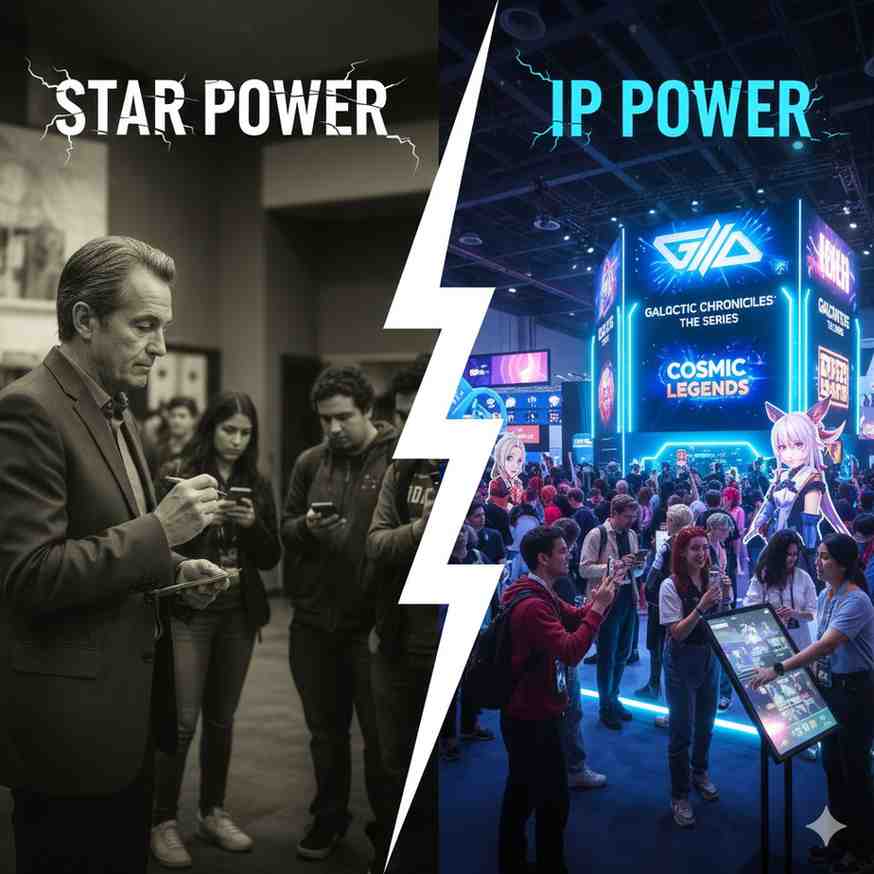
Key highlights
- Stars still matter, but franchises feel safer to fund.
- “IP” promises continuity: sequels, universes, familiar worlds.
- The risk: acting becomes decoration, not the engine.
It’s not that Bollywood has stopped loving stars. It’s that Bollywood has become less patient with uncertainty. A star is a bet on charisma. An IP is a bet on repetition. And repetition looks less frightening to financiers than originality.
You can see it in how films are announced now. Not as singular stories, but as “the next chapter.” Posters begin to resemble brand logos. Titles begin to feel like product lines. Even before the first film has aged, the second is being whispered into existence—because in an anxious industry, speed is mistaken for strategy.
Stars aren’t vanishing. They’re being reorganised. Many are becoming faces inside machines—franchise engines that must keep running. That changes what performance means. A star used to carry a film with presence. Now a star often carries a film with continuity: you are not only watching him; you are returning to a world.
This can be fun. Familiar worlds can feel comforting. But comfort has a shadow. When continuity becomes the primary value, risk becomes “brand damage.” Suddenly, scripts get safer. Characters get flatter. Surprises get filtered out. And the most dangerous sentence appears in the room: “Let’s not experiment.”
For you as a viewer, the emotional experience changes too. You stop asking, “What is this film?” and start asking, “Does it deliver what it promised?” That’s not cinema. That’s consumer satisfaction.
In 2026, expect IP thinking to keep rising. It fits modern attention patterns. It rewards marketing. It makes planning easy. But the hunger for singular films will not vanish. It will simply wait, quietly, until someone dares to make a story that doesn’t ask for your loyalty—only your attention.
Stars will survive. The question is whether they will still take risks as artists—or only as brand ambassadors of franchises.
Leave a Reply