
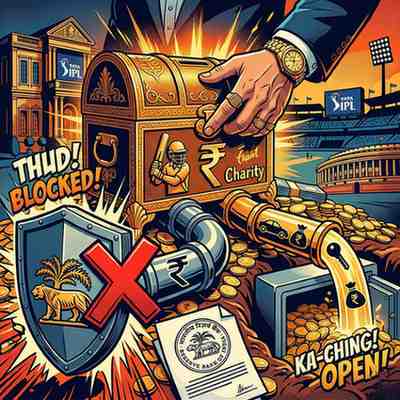
New Delhi, March 2026 — As the Indian Premier League (IPL) continues its reign as one of the world’s most lucrative sporting properties, a simmering controversy has resurfaced: Why does the Board of Control for Cricket in India (BCCI), the world’s richest cricket body, pay little to no direct income tax on its multi-billion dollar tournament?
What the BCCI calls “promotion of sport,” critics describe as a masterclass in using “charity” as a shield for a high-octane commercial empire.
The “Charitable” Mask: Section 11 and 12A
For decades, the BCCI has operated under a specific legal framework. It is registered as a charitable institution under Section 12A of the Income Tax Act. This classification allows the board to claim massive tax exemptions under Section 11, provided it spends at least 85% of its income on its declared objective: the promotion of cricket.
At the time this status was granted in 1996, the IPL didn’t exist, and cricket was viewed primarily as a national pastime rather than a commercial juggernaut. Under this “General Public Utility” label, the BCCI effectively bypasses the corporate tax rates that other multi-billion dollar businesses must pay.
The Commercial Distortion: IPL’s Explosive Growth
The launch of the IPL in 2008 fundamentally altered the BCCI’s character. What began as a venture with a modest surplus has ballooned into a commercial titan. By the 2023 season, the IPL alone generated ₹11,769 crore in total revenue, with a reported surplus of approximately ₹5,120 crore.
The Income Tax Department has repeatedly challenged this status, arguing that the IPL is a “high-intensity commercial entertainment project”. Regulators point to a 2008 amendment stating that if an entity engages in business-like activities for a fee, it may lose its charitable status for that year.
The Legal Tussle: A “Rock-Solid” Defense
The BCCI’s defense has remained consistent: its core object is the promotion of cricket, and the IPL is merely a “tool” to generate resources for infrastructure, domestic tournaments, and women’s cricket.
In 2021, the Mumbai Income Tax Appellate Tribunal (ITAT) ruled in favor of the BCCI, stating that organized commercial activity does not automatically disqualify an entity from its charitable registration as long as its primary objective remains unchanged. Consequently, the BCCI continues to enjoy “selective framing” as a promoter, despite the IPL contributing nearly 59% of its total annual revenue.
A Question of Fairness
The controversy highlights a stark contrast in India’s tax regime. While research institutions, universities, and biotech startups face rigorous tax burdens, a commercial sports ecosystem remains protected under the label of “public utility”. Analysts suggest this reflects a “regulatory capture,” where the immense popularity and political influence of cricket make strict enforcement a sensitive issue.
Bottom Line
The ongoing “tug-of-war” between the Finance Ministry and the BCCI remains sub-judice. As the IPL’s valuation continues to soar, the question isn’t just about legality, but fairness: Should a billion-dollar league be allowed to wear the mask of charity while other nation-building sectors pay their full share?
Leave a Reply