
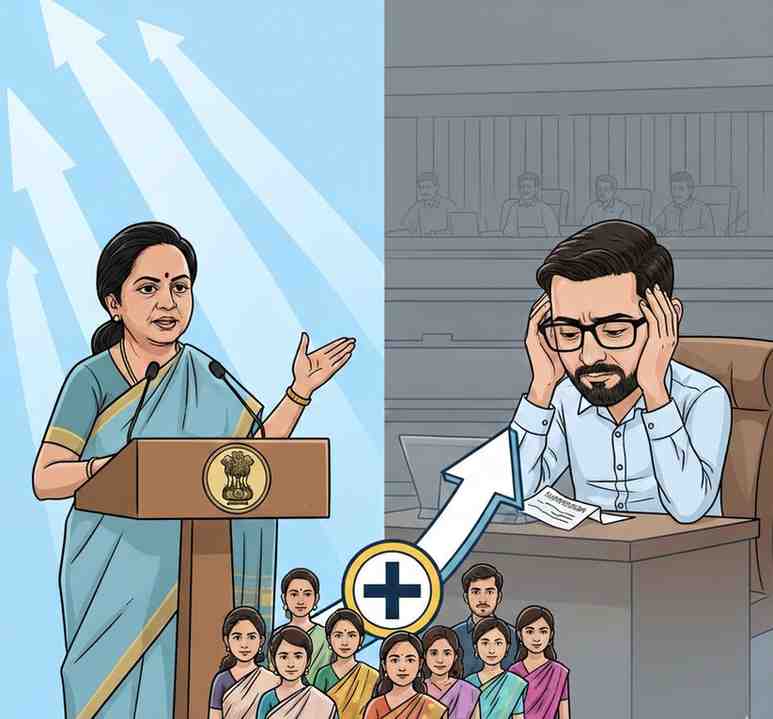
NEW DELHI, February 2026 — Finance Minister Nirmala Sitharaman has robustly defended the government’s fiscal policies, dismissing claims that the Indian middle class is being crushed by a rising tax burden. Addressing the Rajya Sabha, the Finance Minister argued that record-breaking personal income tax collections are a victory for economic formalization, rather than a sign of “middle-class suffering.”
The debate was sparked by AAP MP Raghav Chadha, who alleged that the middle class is being “sandwiched” between stagnant salaries and 6.8% inflation.
The “Tax Collection” Paradox
The core of the Opposition’s argument rested on a historic shift: for the first time, personal income tax (PIT) collections have surpassed corporate tax collections. Critics cited this as evidence that the individual taxpayer is carrying the nation’s financial weight while corporations enjoy leniency.
Sitharaman labeled this a “fundamental misdiagnosis.” She argued that PIT growth isn’t due to higher rates, but a massive structural expansion of the tax base.
- The Numbers: In the last 11 years, the number of taxpayers (those filing returns or subject to TDS) more than doubled—jumping from 5.26 crore to 12.13 crore.
- The Logic: With a CAGR of 7.9% in taxpayer numbers, the Minister asserted that more citizens are entering the formal economy, moving away from an “elite-only” tax bracket to a broader, more inclusive one.
Relief Measures vs. The “Sandwich” Narrative
To counter the “suffering” narrative, the Finance Minister highlighted specific relief measures integrated into the latest budget cycles:
- Zero Tax Threshold: Under the new tax regime, individuals with salaries up to ₹12.75 lakhs effectively pay no tax after accounting for standard deductions.
- Standard Deduction: This has been consistently enhanced to provide immediate liquidity to the salaried class.
- GST Impact: Sitharaman pointed out that GST rationalization has lowered the cost of daily household items, keeping monthly item-rate inflation at historical lows.
“Suppression cannot coexist with rising real incomes and record-low inflation,” the FM stated, suggesting that upward mobility is the defining characteristic of the current workforce.
The Debt Debate: Center vs. States
The confrontation shifted gears when the discussion turned to rising national debt. While the Opposition raised concerns about the Union’s borrowing, Sitharaman pivoted the spotlight toward state-level fiscal management.
Using Tamil Nadu as a case study, she quoted former CM Edappadi K. Palaniswami to highlight a stark contrast:
- Historical Debt: It took 73 years for successive governments in Tamil Nadu to accumulate ₹5 lakh crore in total debt.
- Recent Spike: Under the current DMK administration, ₹4.56 lakh crore has been added in just four years since 2021.
Bottom Line
The Finance Minister’s stance remains clear: the “widening of the tax net” is a sign of a maturing economy where more people earn taxable income. While the Opposition continues to highlight the “pinch” felt by the common man, the government maintains that the middle class is not being crushed—it is simply growing too fast for the old economic labels to fit.
Leave a Reply